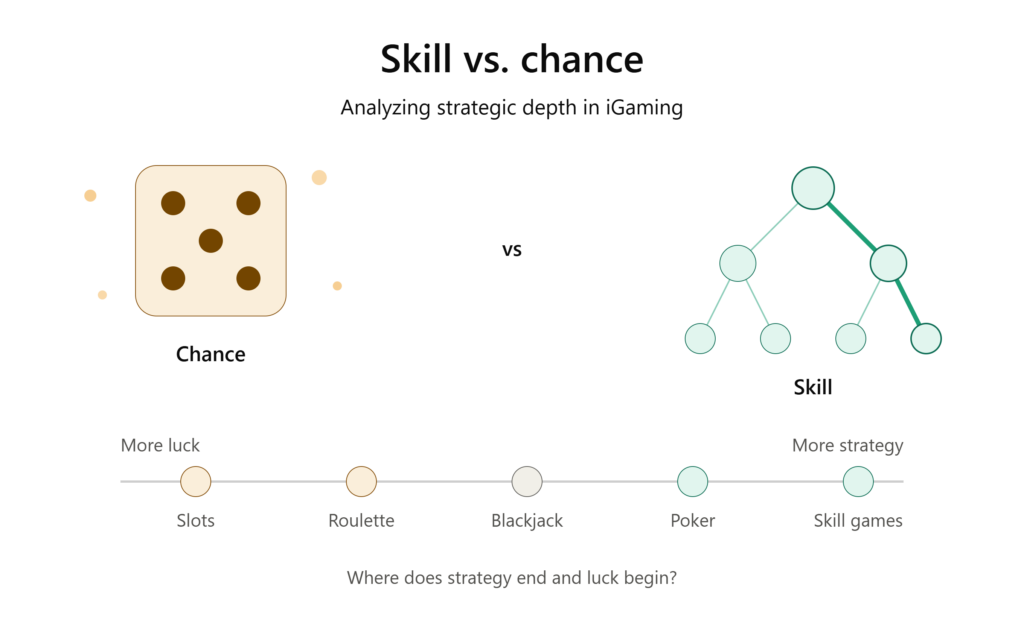
Not every online game relies on luck in the same way. In some, players make decisions that can greatly improve their chances of success. In others, the outcome solely depends on random events. Knowing the difference between skill and chance helps players choose games that match their interests. It also helps them to set realistic expectations, which is critical.
In iGaming, this distinction also matters when evaluating game design, player controls, and the role of your strategy. In some games, skill matters, while in others skill does not always guarantee a win.
What Separates Skill From Chance
When analyzing skill vs. chance, players need a good base to search for codes and other bonus events, which can increase their chances of success. The list of bonus codes here contributes to players’ higher chances of winning because of a boosted balance. This can also be considered a skill: maximizing your buying power by using the latest promo codes and bonus offerings for maximum benefits. Players who have bonuses, cashback, and other benefits usually have a higher chance to hit it big and win in both casino and games.
Skill-based games reward knowledge, practice, timing, and decision-making in gaming, while chance-based games rely mainly on random outcomes. Traditional slot games and roulette are popular examples. Examples of games requiring skills include poker, where players assess probabilities and opponents, and certain competitive games as well, where experience can improve performance.
Many games also sit somewhere between these categories. Poker involves luck in the cards dealt, but strategy influences how players end up in the end. Sports betting also requires research and judgement, yet the result remains uncertain and can be affected by other factors.
How Strategy Changes the Experience
The strategic attribute of a game comes from having meaningful choices and understanding their consequences. A game with several possible moves, changing conditions, and a need to manage risks will usually reward careful thinking and planning.
Poker is a good example of this, where players consider their cards, betting patterns, position, and the possible actions of their opponents. Over time, players acquire experience, and skilled players usually make better decisions than beginners, but individual hands can still be lost through chance.
A slot game, by contrast, can also offer choices about bet size or bonus buy features, but those options do not necessarily improve the underlying odds, as slots are volatile and random. A more interactive interface should not be mistaken for greater control.
The Role of Probability
Probability helps explain why skill and chance are so difficult to separate in some cases. In a game with random outcomes, an unlikely result can still happen. A player may lose several rounds in a row without anything being wrong with the game. A short winning streak
does not prove that a particular strategy works, either.
Expected value is another useful concept. It describes the average result a player might expect to get over many repetitions. It is based on the possible outcomes and their probabilities. In casino games with a house edge, the player’s expected return is usually negative over time.