Introduction
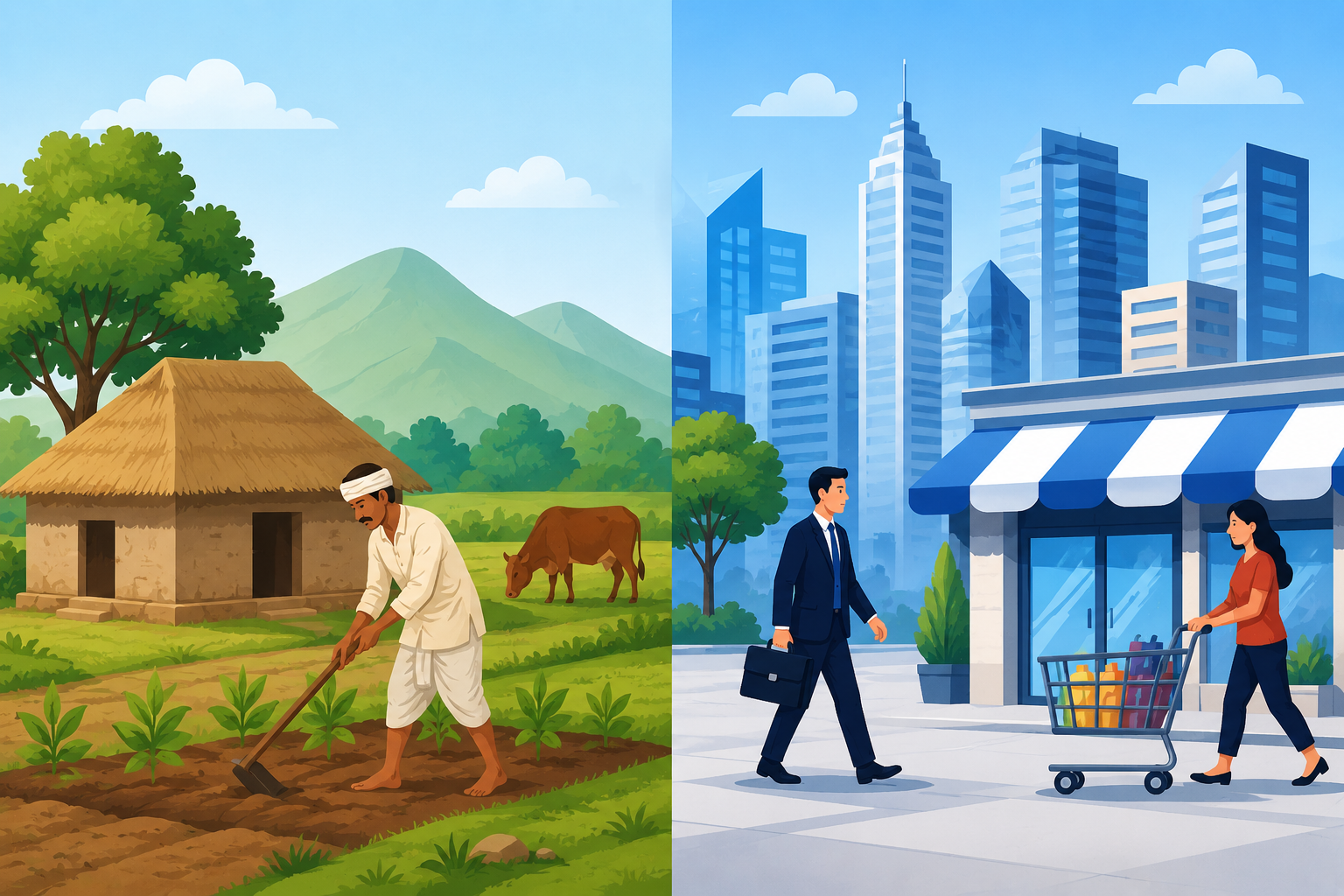
Economic systems shape the way countries produce goods, distribute resources, and meet the needs of their populations. Every nation follows an economic model that influences business activities, employment opportunities, trade, consumer choices, and overall economic development. Among the various economic systems, the traditional economy and the market economy represent two distinctly different approaches to organizing economic activity.
A traditional economy is one of the oldest economic systems in the world. It relies heavily on customs, cultural beliefs, traditions, and long-established practices that have been passed down through generations. Communities operating under this system often depend on agriculture, fishing, hunting, and handcrafted goods for survival. Economic decisions are influenced by family traditions and community values rather than market demand or government intervention.
In contrast, a market economy is driven by supply and demand. Individuals and businesses are free to produce, sell, and purchase goods and services with minimal government control. Competition, innovation, consumer preferences, and profit motives determine how resources are allocated. Many of the world’s largest economies, including the United States, Canada, Australia, and several European nations, primarily operate under market-based principles.
Understanding the differences between these two systems is essential for students, entrepreneurs, investors, policymakers, and anyone interested in economics. Each system has unique strengths and limitations that affect productivity, economic growth, wealth distribution, and quality of life.
This guide provides a detailed comparison of the traditional economy and the market economy, explaining how each system works, their defining characteristics, advantages, disadvantages, and their impact on modern societies.
What Is a Traditional Economy?
A traditional economy is an economic system in which customs, traditions, cultural practices, and historical methods determine how goods and services are produced and distributed.
Unlike modern economies, production is not based primarily on consumer demand or technological innovation. Instead, communities continue using methods that have remained relatively unchanged for generations.
Families often inherit occupations from previous generations. Farmers continue farming, fishermen continue fishing, and artisans continue producing traditional crafts using familiar techniques.
Economic activities are closely connected to local culture, religious beliefs, and community cooperation.
Key Characteristics of a Traditional Economy
A traditional economy has several defining characteristics that distinguish it from other economic systems.
Dependence on Customs and Traditions
Economic decisions are based on longstanding cultural practices rather than changing market conditions.
People generally continue occupations inherited from their parents or grandparents.
Limited Technology
Production methods usually rely on basic tools and manual labor instead of advanced machinery.
Modern automation and industrial equipment play only a minor role.
Agriculture-Based Production
Most traditional economies depend heavily on:
- Farming
- Livestock
- Hunting
- Fishing
- Forestry
- Handicrafts
Natural resources provide the foundation for economic survival.
Community Cooperation
Resources are often shared among families and communities.
Rather than competing for profits, community members work together to meet collective needs.
Limited Trade
Trade generally occurs within nearby villages or neighboring communities.
Bartering may still be common, with goods exchanged directly instead of using money.
How a Traditional Economy Works
The functioning of a traditional economy revolves around local production and consumption.
For example:
A farming family grows crops.
Some crops feed the family.
Extra crops may be exchanged for clothing, livestock, or handmade tools.
Production levels are determined by family needs rather than profit expectations.
Economic activities follow seasonal patterns influenced by weather and natural resources.
Because communities are relatively self-sufficient, dependence on global markets remains low.
Advantages of a Traditional Economy
Although traditional economies are less common today, they offer several important advantages.
Strong Community Relationships
Communities work together rather than competing against one another.
Families support each other through shared labor and resource distribution.
This cooperation strengthens social bonds.
Environmental Sustainability
Traditional production methods generally consume fewer natural resources.
Many communities harvest crops, fish, and timber responsibly because their long-term survival depends on preserving the environment.
Low Unemployment
Every family member usually contributes to community activities.
People have defined roles within society, reducing unemployment in the traditional sense.
Cultural Preservation
Traditional economies help preserve:
- Local customs
- Indigenous knowledge
- Traditional farming methods
- Handcrafted skills
- Cultural heritage
These practices often survive for centuries.
Economic Stability
Communities experience fewer dramatic economic fluctuations because they are less dependent on stock markets, international trade, or financial speculation.
Disadvantages of a Traditional Economy
Despite its strengths, the traditional economy has significant limitations.
Limited Economic Growth
Economic expansion occurs slowly because production methods rarely change.
Without technological advancement, productivity remains relatively low.
Low Income Levels
Communities generally produce only enough goods for local consumption.
Opportunities to generate higher incomes are limited.
Limited Access to Modern Healthcare and Education
Remote traditional communities may have reduced access to:
- Hospitals
- Universities
- Financial institutions
- Internet services
- Transportation infrastructure
This limits long-term development.
Vulnerability to Natural Disasters
Since agriculture often forms the backbone of the economy, droughts, floods, and crop failures can significantly affect livelihoods.
Limited Consumer Choice
Consumers usually purchase locally available products.
Imported goods and advanced technologies may be difficult to access.
What Is a Market Economy?
A market economy is an economic system in which businesses and consumers make most economic decisions through the forces of supply and demand.
Unlike a traditional economy, production is guided by consumer preferences rather than cultural customs.
Private businesses decide:
- What products to manufacture
- How much to produce
- What prices to charge
- Which markets to enter
Consumers influence production through their purchasing decisions.
Businesses compete to attract customers by offering better prices, higher quality products, and innovative services.
Key Characteristics of a Market Economy
Several important features define a market economy.
Private Ownership
Individuals and businesses own most property and productive resources.
Private ownership encourages investment and entrepreneurship.
Consumer Choice
Consumers can choose from many competing products and services.
Businesses must continually improve quality to remain competitive.
Competition
Multiple companies compete for customers.
Competition often leads to:
- Lower prices
- Better products
- Greater innovation
- Improved customer service
Profit Motivation
Businesses seek profits by satisfying customer demand.
Higher profits encourage investment and business expansion.
Limited Government Intervention
Although governments establish legal frameworks and regulations, businesses generally make independent production decisions.
Advantages of a Market Economy
A market economy is widely recognized for encouraging innovation, entrepreneurship, and economic growth. Since businesses compete to attract customers, they are constantly improving products and services while searching for more efficient production methods.
Below are some of the major advantages of a market economy.
1. Encourages Innovation
Competition motivates businesses to develop new products, improve existing services, and adopt modern technologies.
Companies invest in research and development to gain a competitive advantage, leading to technological progress across industries.
Examples include:
- Artificial intelligence
- Electric vehicles
- Digital banking
- Cloud computing
- Renewable energy technologies
Innovation not only benefits businesses but also improves consumers’ quality of life.
2. Greater Consumer Choice
Unlike traditional economies, where product options are limited, market economies offer consumers a wide variety of goods and services.
Customers can compare:
- Prices
- Quality
- Features
- Brands
- Customer service
Businesses that fail to meet customer expectations risk losing market share to competitors.
3. Economic Growth
One of the strongest advantages of a market economy is its ability to generate long-term economic growth.
As businesses expand, they:
- Create jobs
- Increase production
- Invest in technology
- Generate tax revenue
- Encourage entrepreneurship
Higher productivity contributes to rising national income and improved living standards.
4. Efficient Resource Allocation
Resources are generally directed toward products and services with the highest consumer demand.
If demand increases for a product, businesses increase production.
If demand decreases, companies reduce production and shift resources elsewhere.
This flexibility helps minimize waste.
5. Encourages Entrepreneurship
Individuals are free to start businesses and pursue new opportunities.
Entrepreneurs who identify market needs can develop innovative products and build successful companies.
This entrepreneurial environment supports:
- Small businesses
- Startups
- Family businesses
- Global corporations
6. Higher Productivity
Competition encourages businesses to improve efficiency.
Companies adopt modern equipment, automation, and advanced management practices to reduce costs and increase output.
Higher productivity benefits both producers and consumers.
Disadvantages of a Market Economy
Although market economies create opportunities, they also present several challenges.
Income Inequality
Success often depends on education, skills, investment, and access to resources.
As a result, wealth may become concentrated among a relatively small portion of the population while others struggle financially.
Economic Instability
Market economies experience business cycles that include:
- Economic expansion
- Recession
- Inflation
- Financial crises
Businesses may face uncertainty during periods of economic downturn.
Unemployment
Competition forces inefficient businesses to close or reduce operations.
Employees may lose their jobs if companies fail to remain competitive.
Technological automation can also replace certain occupations.
Environmental Concerns
Businesses seeking higher profits may overuse natural resources if environmental regulations are weak.
Examples include:
- Pollution
- Deforestation
- Overfishing
- Industrial waste
- Carbon emissions
Governments often introduce environmental laws to reduce these risks.
Market Failures
Sometimes markets fail to allocate resources efficiently.
Examples include:
- Monopolies
- Public goods
- Externalities
- Information asymmetry
Government intervention may become necessary to address these problems.
Traditional Economy vs Market Economy
Although both systems aim to satisfy human needs, they operate in fundamentally different ways.
The traditional economy relies on customs and cultural practices, while the market economy depends on competition and consumer demand.
The following sections compare their major differences.
Decision-Making
Traditional Economy
Economic decisions are based on customs, traditions, and community practices.
Families often continue occupations inherited from previous generations.
Market Economy
Businesses and consumers make decisions independently.
Supply and demand determine production levels and pricing.
Ownership
Traditional Economy
Resources are often shared among families or communities.
Private ownership exists but is usually less significant.
Market Economy
Private individuals and businesses own most resources, land, factories, and companies.
Ownership encourages investment and innovation.
Pricing
Traditional Economy
Prices may remain relatively stable because production is based on community needs rather than market competition.
Bartering may also occur.
Market Economy
Prices change according to supply and demand.
Competition influences both pricing and product quality.
Technology
Traditional Economy
Production relies on simple tools and manual labor.
Technological advancement is generally slow.
Market Economy
Businesses adopt modern technologies to improve efficiency and remain competitive.
Innovation plays a central role.
Employment
Traditional Economy
Occupations are usually inherited through family traditions.
Employment opportunities remain relatively stable but limited.
Market Economy
Individuals choose careers based on education, skills, and market opportunities.
Employment changes as industries evolve.
Economic Growth
Traditional Economy
Growth is gradual because production methods change very little.
Economic activity focuses on meeting local needs.
Market Economy
Innovation, investment, and entrepreneurship drive faster economic growth.
Businesses continuously expand into new markets.
Comparison Table
| Feature | Traditional Economy | Market Economy |
| Decision Making | Customs and traditions | Supply and demand |
| Ownership | Community or family-based | Private ownership |
| Main Objective | Meet local needs | Earn profits and satisfy demand |
| Technology | Limited | Advanced |
| Competition | Very low | High |
| Consumer Choice | Limited | Extensive |
| Innovation | Slow | Rapid |
| Economic Growth | Gradual | Fast |
| Pricing | Tradition or barter | Market forces |
| Employment | Family occupations | Open labor market |
Real-World Examples of Traditional Economies
Although few countries rely entirely on traditional economies today, elements of this system still exist in certain communities.
Examples include:
- Indigenous communities in the Arctic
- Remote tribal villages in Africa
- Rural communities in parts of Asia
- Isolated regions of South America
- Traditional farming communities in Oceania
These communities often depend on agriculture, hunting, fishing, and handcrafted goods for their livelihoods.
Real-World Examples of Market Economies
Many developed nations operate primarily as market economies.
Examples include:
- United States
- Canada
- Australia
- Singapore
- New Zealand
- United Kingdom
Although governments regulate these economies, private businesses drive most production and investment decisions.
Which Economic System Is Better?
There is no single economic system that is perfect for every country. The effectiveness of an economy depends on several factors, including a nation’s natural resources, population, political stability, culture, level of industrialization, and long-term development goals.
A traditional economy may work well for small communities that value self-sufficiency and cultural preservation. However, it is generally less suitable for countries seeking rapid industrial growth and technological advancement.
On the other hand, a market economy supports innovation, entrepreneurship, and higher productivity. While it has helped many nations achieve significant economic growth, it can also create income inequality and environmental challenges if not properly regulated.
For these reasons, many countries choose a balanced approach rather than relying entirely on one system.
Can Traditional and Market Economies Coexist?
Yes. In reality, very few countries operate under a purely traditional or purely market economy. Most nations combine elements of different economic systems to meet their social and economic objectives.
For example, a country may encourage private businesses to compete freely while also preserving traditional industries such as agriculture, handicrafts, or fishing.
Governments often protect cultural heritage through subsidies, training programs, and tourism initiatives, allowing traditional practices to continue alongside modern business activities.
This combination enables countries to preserve their identity while benefiting from economic growth and technological progress.
Understanding the Mixed Economy
A mixed economy combines characteristics of both market and government-controlled systems. While private businesses produce most goods and services, governments regulate industries, collect taxes, and provide essential public services.
Many of today’s leading economies are considered mixed economies because they balance free-market competition with government oversight.
Common government responsibilities include:
- Building infrastructure
- Providing healthcare
- Supporting education
- Maintaining national defense
- Regulating financial markets
- Protecting consumers
- Enforcing environmental standards
This balance helps reduce some of the disadvantages associated with a purely market-driven economy.
Impact on Businesses
Economic systems directly influence how businesses operate.
Businesses in a Traditional Economy
Businesses are generally small, family-owned, and locally focused.
Common characteristics include:
- Limited production
- Local customer base
- Handmade products
- Minimal technology
- Community-based trading
Growth opportunities may be limited, but businesses often enjoy strong relationships with local customers.
Businesses in a Market Economy
Businesses operate in a highly competitive environment.
Success depends on:
- Product quality
- Competitive pricing
- Innovation
- Customer service
- Marketing
- Operational efficiency
Companies must continuously adapt to changing consumer preferences to remain competitive.
Impact on Consumers
Consumers experience very different conditions under each economic system.
In a Traditional Economy
Consumers typically purchase locally produced goods.
Choices may be limited, but products often reflect local culture and craftsmanship.
Because production focuses on community needs rather than profits, consumer preferences play a smaller role in determining what is produced.
In a Market Economy
Consumers benefit from a wide selection of products and services.
Competition encourages businesses to improve quality while offering competitive prices.
Consumers also influence the market through their purchasing decisions, making demand a key driver of production.
Impact on Innovation
Innovation is one of the biggest differences between the two systems.
Traditional Economy
Innovation occurs slowly because communities often rely on established production methods passed down through generations.
Preserving tradition is usually more important than adopting new technologies.
Market Economy
Innovation is a major driver of economic success.
Businesses invest in research and development to create better products, improve efficiency, and gain a competitive advantage.
This continuous innovation contributes to advances in technology, healthcare, transportation, communication, and manufacturing.
Globalization and Economic Systems
Globalization has significantly influenced how economies operate.
Even communities with traditional economic practices increasingly interact with national and international markets through tourism, trade, and digital communication.
Similarly, market economies benefit from global trade by accessing new customers, importing raw materials, and expanding international business operations.
While globalization creates new opportunities, it also introduces challenges such as increased competition, cultural change, and dependence on international markets.
Future of Traditional and Market Economies
The future of economic systems is likely to involve greater integration of traditional values with modern economic practices.
Traditional communities may continue preserving cultural heritage while adopting selected technologies that improve healthcare, education, and productivity.
At the same time, market economies are expected to place greater emphasis on sustainability, responsible business practices, and environmental protection.
Technological advancements such as artificial intelligence, automation, renewable energy, and digital finance will continue shaping how businesses and consumers interact within market-based systems.
Frequently Asked Questions
What is the main difference between a traditional economy and a market economy?
A traditional economy relies on customs, traditions, and community practices, whereas a market economy is driven by supply and demand, competition, and consumer choice.
Which countries have a traditional economy?
Pure traditional economies are rare today, but some indigenous and rural communities in parts of Africa, Asia, South America, and the Arctic continue to follow traditional economic practices.
Which countries use a market economy?
Countries such as the United States, Canada, Australia, New Zealand, Singapore, and the United Kingdom operate primarily as market economies, although they also include government regulation.
Why is competition important in a market economy?
Competition encourages businesses to improve quality, lower prices, develop innovative products, and provide better customer service, ultimately benefiting consumers.
Is a traditional economy still relevant today?
Yes. Traditional economies continue to preserve cultural heritage, promote sustainable resource use, and support local communities. While they are less common at the national level, they remain important in many indigenous and rural regions.
Final Comparison
| Aspect | Traditional Economy | Market Economy |
| Basis | Customs and traditions | Supply and demand |
| Ownership | Community or family | Private individuals and businesses |
| Technology | Basic | Advanced |
| Competition | Minimal | High |
| Consumer Choice | Limited | Wide variety |
| Innovation | Slow | Continuous |
| Economic Growth | Gradual | Rapid |
| Employment | Family occupations | Open labor market |
| Primary Goal | Meet community needs | Maximize efficiency and profits |
Conclusion
Understanding the differences between a traditional economy and a market economy is essential for anyone studying economics, managing a business, or exploring how societies allocate resources.
A traditional economy emphasizes cultural values, cooperation, and sustainability, making it well-suited for preserving heritage and supporting close-knit communities. However, its limited use of technology and slower pace of development can restrict economic growth and consumer choice.
In contrast, a market economy promotes innovation, entrepreneurship, and competition. It encourages businesses to improve products and services while giving consumers greater freedom to choose. Although this system has driven significant economic progress around the world, it also requires effective regulation to address challenges such as inequality, market failures, and environmental concerns.
In practice, most modern nations combine elements of both systems, creating balanced economies that encourage growth while protecting public interests. By understanding the strengths and weaknesses of each approach, individuals and policymakers can make more informed economic decisions.