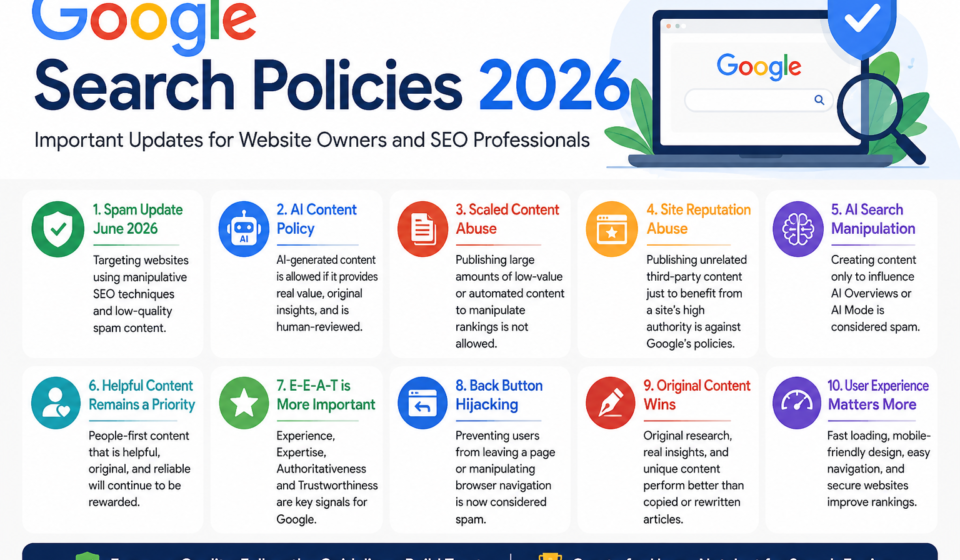

Google regularly updates its Search policies to improve the quality of search results and provide users with the most relevant, helpful, and trustworthy information. In 2026, Google introduced several important policy updates that affect bloggers, website owners, SEO professionals, and digital marketers.
If you own a website or rely on organic traffic from Google Search, understanding these changes is essential. Following Google’s guidelines can help protect your rankings, while ignoring them could result in lower visibility or even manual penalties.
This guide explains the most significant Google Search policy updates in 2026 and what you should do to keep your website compliant.
Why Google Updates Its Policies
Google’s primary goal is to deliver helpful, reliable, and people-first content. Every policy update is designed to:
- Improve search quality
- Reduce spam
- Reward original content
- Prevent manipulation of search rankings
- Protect users from misleading information
Instead of focusing on search engines, Google encourages publishers to create content that genuinely helps readers.
1. June 2026 Google Spam Update
One of the biggest updates in 2026 was the June Spam Update, which targeted websites using manipulative SEO tactics.
Google focused on websites involved in:
- Mass-produced low-quality content
- Keyword stuffing
- Hidden text
- Cloaking
- Deceptive redirects
- Automatically generated spam pages
Many websites that relied on outdated SEO techniques experienced significant ranking losses after this update.
What You Should Do
- Publish original articles.
- Avoid copying competitors.
- Remove thin or duplicate content.
- Focus on quality rather than quantity.
2. Google’s AI Content Policy
Artificial Intelligence has become an important part of content creation. However, Google has made it clear that AI-generated content is not automatically good or bad.
The key factor is whether the content is genuinely helpful.
Google allows AI-assisted writing if it:
- Provides useful information
- Demonstrates expertise
- Offers original insights
- Is reviewed and edited by humans
Google discourages publishing thousands of AI-generated articles without adding value.
Best Practices
- Use AI to assist with research and drafting.
- Edit every article manually.
- Add real examples and personal expertise.
- Include accurate and up-to-date information.
3. Scaled Content Abuse
Google introduced stronger enforcement against Scaled Content Abuse.
This refers to producing large amounts of pages primarily to manipulate search rankings rather than help users.
Examples include:
- Publishing thousands of AI articles overnight
- Automatically translating content
- Rewriting existing articles with little change
- Creating hundreds of nearly identical location pages
Google’s algorithms are becoming increasingly effective at identifying these patterns.
How to Avoid It
Instead of publishing 100 low-quality articles, publish 10 comprehensive and valuable guides.
Quality consistently outperforms quantity.
4. Site Reputation Abuse
Another major policy targets Site Reputation Abuse, sometimes called “Parasite SEO.”
This happens when unrelated third parties publish content on trusted websites solely to gain ranking advantages.
Examples include:
- A technology website publishing casino reviews
- A news website hosting unrelated affiliate pages
- High-authority domains selling irrelevant sponsored articles
Google now evaluates whether published content aligns with the website’s primary purpose.
Best Practice
Only publish guest posts and sponsored content that match your website’s niche and provide value to your audience.
5. AI Search Manipulation
As Google expands AI-powered search experiences, it has introduced policies against manipulating AI-generated answers.
Google discourages websites from creating content solely to appear in AI-generated search responses.
Examples include:
- Publishing fake “Top 10” lists
- Creating misleading recommendation pages
- Generating repetitive AI-focused pages
Instead, websites should focus on creating trustworthy and original resources.
6. Helpful Content Remains a Priority
Google continues rewarding websites that produce people-first content.
Helpful content usually includes:
- Clear explanations
- Accurate facts
- Practical advice
- Original research
- Real-life examples
- Expert opinions
Articles written only to target keywords are much less likely to perform well.
7. E-E-A-T Is More Important Than Ever
Google places increasing emphasis on E-E-A-T, which stands for:
- Experience
- Expertise
- Authoritativeness
- Trustworthiness
Although E-E-A-T is not a direct ranking factor, it strongly influences how Google evaluates content quality.
You can improve E-E-A-T by:
- Writing from real experience
- Adding author biographies
- Citing reliable sources
- Updating outdated articles
- Maintaining factual accuracy
8. Back Button Hijacking Is Considered Spam
Google now treats websites that manipulate browser navigation as spam.
Examples include:
- Preventing visitors from leaving a page
- Redirecting users unexpectedly
- Trapping users with JavaScript
These practices create a poor user experience and may negatively impact search rankings.
9. Original Content Wins
Google increasingly rewards original work over rewritten or copied articles.
High-performing content often includes:
- Original case studies
- Surveys
- Personal insights
- Expert interviews
- Custom graphics
- Unique data
Simply rewriting competitors’ articles is becoming much less effective.
10. User Experience Matters More Than Ever
Google evaluates how users interact with websites.
Important factors include:
- Fast loading speed
- Mobile-friendly design
- Secure HTTPS connection
- Easy navigation
- Minimal intrusive advertisements
- Clear page structure
A positive user experience can improve engagement and support better search performance.
SEO Best Practices for 2026
To stay compliant with Google’s latest policies, follow these recommendations:
- Create original, high-quality content.
- Use AI responsibly and always edit your work.
- Focus on user intent instead of keyword stuffing.
- Build natural backlinks from reputable websites.
- Publish content within your site’s niche.
- Update old articles regularly.
- Improve page speed and Core Web Vitals.
- Demonstrate expertise and trustworthiness.
- Avoid spammy SEO shortcuts.
- Prioritize long-term value over quick ranking gains.
Common Mistakes to Avoid
Many websites lose rankings because they:
- Publish duplicate content
- Buy spammy backlinks
- Use excessive AI-generated articles
- Stuff keywords unnaturally
- Create doorway pages
- Ignore user experience
- Publish irrelevant sponsored content
Avoiding these mistakes can significantly reduce the risk of Google penalties.
Final Thoughts
Google’s 2026 Search policies reinforce a simple message: create content for people, not search engines. While AI tools and SEO strategies continue to evolve, long-term success depends on originality, expertise, and user value.
Website owners who invest in high-quality, trustworthy, and well-researched content are more likely to maintain strong rankings and adapt successfully to future algorithm updates. Instead of chasing shortcuts, focus on building a website that genuinely answers users’ questions and solves their problems. That approach remains the most reliable SEO strategy in 2026 and beyond.