
Introduction
Every successful startup begins with an idea, but transforming that idea into a functional mobile application requires careful planning, technical expertise, and a clear business strategy. Many entrepreneurs have innovative concepts yet struggle to build products that attract users and compete in today’s fast-moving digital market. This is why app development for startups with Garage2Global has become a valuable solution for founders looking to launch scalable and market-ready applications.
Unlike traditional software projects, startup app development focuses on validating ideas quickly, building an efficient Minimum Viable Product (MVP), and improving the application based on real user feedback. This approach minimizes development risks, reduces unnecessary costs, and allows startups to enter the market faster. By combining strategic planning with modern technologies, startups can build applications that solve genuine customer problems while preparing for long-term growth.
Garage2Global follows a structured development process that supports startups from the initial concept to product launch. Instead of simply writing code, the team works closely with founders to understand business goals, identify target audiences, choose the right technology stack, and create user-friendly applications. Every stage is designed to maximize efficiency while ensuring the final product meets market expectations.
Whether you’re planning a fintech platform, healthcare application, SaaS product, eCommerce marketplace, or educational app, understanding the complete development journey is essential. This guide explains how app development for startups with Garage2Global helps entrepreneurs transform innovative ideas into successful digital products.
Understanding App Development for Startups
Startup app development is much more than designing screens and developing software. It is a strategic process that combines business planning, user research, design thinking, software engineering, testing, and continuous improvement. Unlike large enterprises with established customer bases, startups must prove that their ideas solve real-world problems before investing heavily in product expansion.
One of the biggest advantages of working with an experienced development partner is avoiding costly mistakes during the early stages. Rather than building dozens of unnecessary features, successful startups prioritize the functions that provide immediate value to users. This lean development strategy helps founders launch sooner while collecting valuable feedback that guides future improvements.
The startup journey also demands flexibility. Market trends, customer expectations, and business priorities often change rapidly, making agile development methodologies especially valuable. Teams can release updates quickly, improve performance, and respond to user feedback without rebuilding the entire application.
Startup Development Lifecycle
| Stage | Primary Goal | Expected Outcome |
| Idea Validation | Confirm market demand | Clear product vision |
| Market Research | Understand competitors and users | Better business strategy |
| MVP Planning | Define essential features | Faster product launch |
| UI/UX Design | Create intuitive user experience | Higher user engagement |
| Development | Build the application | Functional product |
| Testing | Eliminate bugs and improve quality | Reliable performance |
| Launch | Release to the market | Acquire first users |
| Growth | Improve based on analytics | Long-term scalability |
A structured lifecycle ensures every decision supports both technical quality and business objectives. Rather than rushing into development, startups benefit from validating assumptions and prioritizing features that truly matter.
Why Startups Need the Right Development Partner
Choosing the right technology partner can significantly influence a startup’s success. While hiring individual freelancers or building an in-house team may seem appealing, many startups lack the technical leadership needed to manage complex development projects effectively.
An experienced development partner contributes far more than programming skills. They assist with product strategy, technology selection, architecture planning, quality assurance, scalability, and post-launch support. This comprehensive approach reduces technical debt and helps founders focus on growing their businesses.
Some of the key advantages include:
- Faster product development cycles
- Access to experienced developers and designers
- Lower long-term development costs
- Scalable application architecture
- Improved application security
- Continuous technical support
- Agile project management
- Better product quality
For early-stage startups with limited budgets and ambitious goals, having the right partner often makes the difference between launching successfully and delaying market entry.
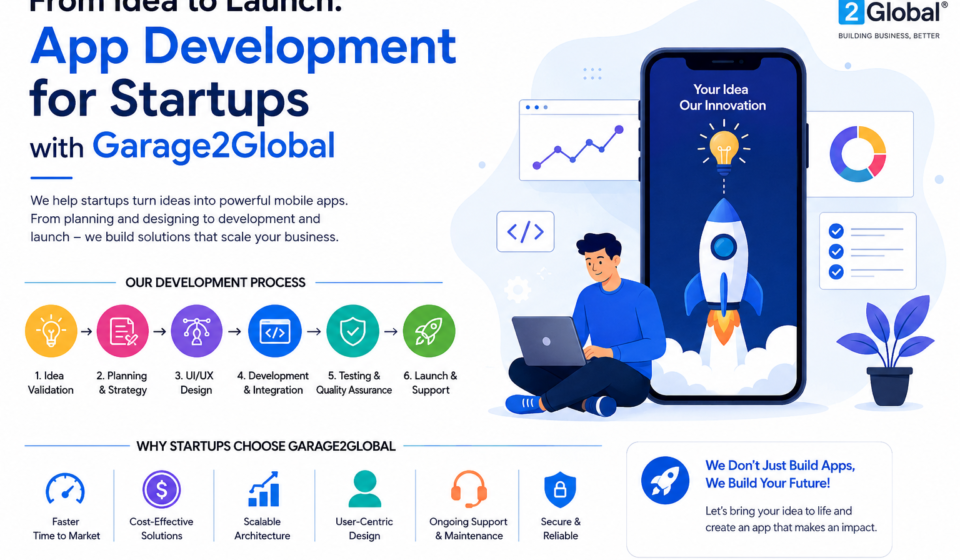
The Garage2Global Development Process
A successful startup app is never built by chance. It follows a structured process that minimizes risks, validates assumptions, and delivers value to users as early as possible. Garage2Global uses a startup-focused workflow that allows founders to move from an idea to a fully functional application without losing sight of their business goals.
Instead of spending months building unnecessary features, the process emphasizes continuous feedback, agile development, and measurable progress. Every phase builds on the previous one, ensuring the application remains aligned with market needs and customer expectations.
| Development Phase | Purpose | Result |
| Discovery | Understand business goals | Clear project direction |
| Planning | Define roadmap and features | Well-organized development |
| Design | Build user-friendly interfaces | Better user engagement |
| Development | Create the application | Functional MVP |
| Testing | Improve quality and security | Stable product |
| Deployment | Launch the application | Ready for users |
| Support | Maintain and improve | Long-term growth |
This systematic approach reduces uncertainty and helps startups launch products with confidence.
Validating Your Startup Idea
Before investing time and money in development, founders should validate whether their idea solves a genuine problem. Many startup failures occur because businesses create products that customers simply don’t need.
Idea validation involves researching competitors, interviewing potential users, studying industry trends, and identifying market gaps. These activities help entrepreneurs understand whether their concept has real commercial potential.
Important questions to answer include:
- What problem does the app solve?
- Who is the ideal customer?
- Are competitors already offering similar solutions?
- What makes this product unique?
- How will the business generate revenue?
The answers form the foundation of every successful startup application.
Planning Core Features
After validating the idea, the next step is identifying which features belong in the first release. One of the biggest mistakes startup founders make is trying to include every possible function before launch.
Instead, focus on building a Minimum Viable Product (MVP). An MVP includes only the essential features required to solve the primary user problem.
For example, an online marketplace may initially include:
- User registration
- Product listings
- Search functionality
- Shopping cart
- Secure payments
Advanced features such as AI recommendations, loyalty programs, or live chat can be added later after gathering user feedback.
Feature Prioritization Example
| High Priority | Medium Priority | Future Updates |
| User Login | Push Notifications | AI Features |
| Dashboard | User Reviews | Loyalty Program |
| Payments | Social Sharing | Advanced Analytics |
| Search | Wish List | Automation Tools |
Prioritizing features helps startups launch faster while keeping development costs under control.
Choosing the Right Technology Stack
Technology decisions affect performance, scalability, maintenance costs, and future growth. Selecting the right tools from the beginning prevents expensive redevelopment later.
Garage2Global evaluates each startup’s business model before recommending technologies. The choice depends on project complexity, target audience, budget, and expected growth.
A modern startup technology stack often includes:
| Component | Recommended Technologies |
| Mobile Development | Flutter, React Native |
| Backend | Node.js, Laravel, Django |
| Database | PostgreSQL, MySQL, Firebase |
| Cloud Services | AWS, Google Cloud, Microsoft Azure |
| Authentication | Firebase Auth, OAuth |
| Analytics | Firebase Analytics, Google Analytics |
Cross-platform frameworks like Flutter and React Native are popular because they reduce development time while delivering high-quality performance on both Android and iOS.
Choosing scalable technologies also ensures the application can handle increasing numbers of users without sacrificing speed or reliability.
Building Your App
Once planning is complete, development begins. This stage transforms wireframes and technical specifications into a working application through collaborative teamwork between developers, designers, testers, and project managers.
Modern startup development relies on Agile methodology, where work is divided into short sprints. Each sprint delivers measurable progress and allows founders to review features before moving to the next phase. This reduces risks and keeps the project aligned with business objectives.
UI/UX Design
An application’s design is often the first thing users notice. A clean, intuitive interface encourages users to explore the app, while a confusing layout can cause them to leave within minutes. Good UI/UX design balances visual appeal with functionality, ensuring users can complete tasks quickly and effortlessly.
Garage2Global begins the design phase by creating wireframes and interactive prototypes. This allows founders to review the app’s structure before development starts, reducing costly revisions later.
Key design priorities include:
- Simple navigation
- Fast loading screens
- Responsive layouts
- Consistent branding
- Accessible interfaces
- Mobile-first design
A positive user experience increases engagement, improves customer satisfaction, and encourages long-term retention.
Agile Development
Modern startup applications are rarely built all at once. Agile development divides the project into smaller sprints, allowing developers to release features gradually while incorporating client feedback throughout the process.
This iterative approach offers several advantages:
- Faster progress tracking
- Better collaboration
- Easier feature adjustments
- Lower development risks
- Continuous quality improvements
Instead of waiting months for a finished product, founders can review updates regularly and suggest improvements before the next sprint begins.
Agile Workflow
| Sprint Stage | Main Activity | Expected Result |
| Planning | Define sprint goals | Clear objectives |
| Development | Build new features | Working functionality |
| Testing | Identify and fix bugs | Improved quality |
| Review | Client feedback | Better product alignment |
| Release | Deploy completed features | Continuous progress |
This workflow keeps development flexible while ensuring the application evolves according to business needs.
Testing and Quality Assurance
Even the most innovative app can fail if it contains bugs, crashes, or security vulnerabilities. Quality assurance is an essential step before launching any application.
Testing ensures that every feature works as intended across different devices, operating systems, and network conditions. It also verifies that user data remains secure and that the application performs well under heavy traffic.
Common testing types include:
- Functional testing
- Performance testing
- Security testing
- Compatibility testing
- Usability testing
- Beta testing
Comprehensive testing helps deliver a stable, reliable product that provides a positive user experience from day one.
Quality Assurance Checklist
| Testing Area | Purpose |
| Functionality | Verify every feature works correctly |
| Performance | Measure speed and responsiveness |
| Security | Protect user information |
| Compatibility | Ensure support across devices |
| User Experience | Improve usability |
| Bug Fixing | Resolve technical issues before launch |
Practical Tips for Startup Founders
Launching a successful app requires more than technical expertise. Startup founders should focus on making informed decisions that support sustainable growth and efficient resource management.
Some practical recommendations include:
- Validate your idea before investing in development.
- Build a Minimum Viable Product instead of a feature-heavy application.
- Listen carefully to early user feedback.
- Prioritize user experience over unnecessary features.
- Choose scalable technologies that support future growth.
- Track key performance metrics after launch.
- Update the application regularly based on customer needs.
- Work with experienced developers who understand startup challenges.
Following these practices helps reduce development risks while increasing the likelihood of long-term success.
Benefits of App Development for Startups with Garage2Global
Choosing the right development partner provides more than technical expertise. It gives startups access to strategic guidance, efficient workflows, and scalable solutions that support business growth.
One of the greatest strengths of app development for startups with Garage2Global is its focus on creating products that balance speed, quality, and scalability. Instead of building unnecessary features, startups receive applications designed to meet current market needs while remaining flexible enough for future expansion.
Key Benefits
| Benefit | Business Value |
| Faster Time-to-Market | Launch products more quickly |
| Startup-Focused Strategy | Align technology with business goals |
| Scalable Architecture | Support future growth |
| Cost-Effective Development | Reduce unnecessary expenses |
| High-Quality UI/UX | Improve customer satisfaction |
| Agile Process | Adapt quickly to market feedback |
| Ongoing Support | Continuous improvements after launch |
| Secure Development | Protect business and customer data |
These benefits help startups reduce uncertainty, improve operational efficiency, and build stronger relationships with their users.
Frequently Asked Questions (FAQs)
1. What is app development for startups with Garage2Global?
App development for startups with Garage2Global is a structured process that helps entrepreneurs transform ideas into market-ready mobile applications. It includes idea validation, MVP planning, UI/UX design, development, testing, deployment, and ongoing support to help startups launch scalable digital products.
2. Why should startups build an MVP first?
A Minimum Viable Product (MVP) allows startups to launch faster with only the essential features. This approach reduces development costs, gathers real user feedback, and helps validate business ideas before investing in advanced functionality.
3. How long does it take to develop a startup app?
Development time depends on the project’s complexity and feature set. A basic MVP can often be completed within a few months, while larger applications with advanced features may require additional development and testing time.
4. Which technology is best for startup mobile apps?
The best technology depends on your goals, budget, and target audience. Many startups choose Flutter or React Native for cross-platform development because they reduce costs while supporting both Android and iOS from a single codebase.
5. How can startups scale their apps after launch?
Startups can scale by monitoring user feedback, improving performance, adding valuable features, strengthening security, and using cloud infrastructure that supports increasing traffic as the business grows.
Conclusion
Building a successful startup application requires much more than writing code. It begins with validating an idea, understanding customer needs, selecting the right technology, and developing a product that solves real-world problems. A structured development process helps reduce risks, optimize resources, and create applications that are prepared for long-term growth.
By focusing on user experience, agile development, continuous testing, and scalable architecture, startups can confidently launch products that stand out in competitive markets. Working with experienced professionals also enables founders to avoid common development mistakes while accelerating their journey from concept to launch.
Whether you’re creating your first digital product or expanding an existing startup, app development for startups with Garage2Global provides a practical framework for building reliable, scalable, and user-focused applications. With careful planning, the right technology stack, and continuous improvement, your startup can transform an innovative idea into a successful mobile app that supports sustainable business growth.