
Introduction
Running a small business means making important decisions every day. Whether you are planning a marketing campaign, improving customer service, managing finances, or launching a new product, your choices directly affect your company’s growth. Without a clear way to organize ideas, business owners often become overwhelmed by too many options.
This is where structured thinking becomes valuable. One popular problem-solving method used by consultants and business leaders is the MECE framework. Many entrepreneurs now ask, is mece good for small businesses when looking for practical ways to improve planning and decision-making.
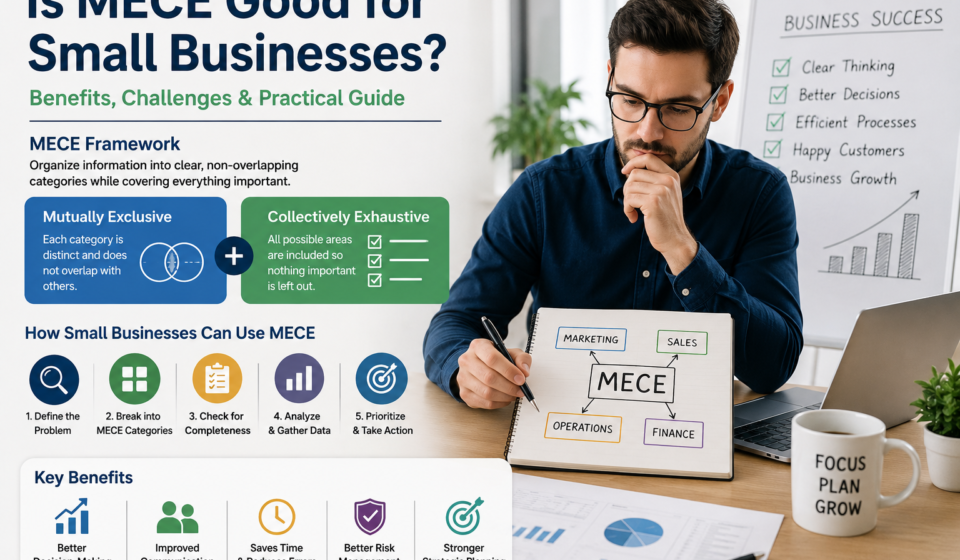
MECE stands for Mutually Exclusive, Collectively Exhaustive. Although the name sounds technical, the concept is surprisingly simple. It helps you divide information into categories that do not overlap while ensuring that nothing important is left out.
Originally developed for management consulting, the MECE principle is now used in startups, marketing agencies, retail businesses, manufacturing companies, financial planning, and service-based organizations. Even solo entrepreneurs can benefit from its organized approach.
In this guide, you’ll learn what MECE means, why it matters for small businesses, where it works best, and how you can apply it without making your business processes overly complicated.
What Is the MECE Framework?
MECE is a structured thinking model designed to simplify complex decisions.
The two core principles are straightforward:
- Mutually Exclusive means each category should be separate without overlapping.
- Collectively Exhaustive means all possible options should be included so nothing important is missed.
Imagine you’re reviewing your company’s monthly expenses.
Instead of mixing different costs together, you divide them into categories like:
- Payroll
- Marketing
- Rent
- Utilities
- Software
- Inventory
- Taxes
Each expense belongs to only one category, making your financial reports much easier to understand.
This organized structure reduces confusion and allows business owners to identify opportunities more quickly.
Why Was MECE Created?
The MECE framework became popular through global consulting firms because consultants often work with complicated business problems.
Large companies may have hundreds of products, thousands of employees, and operations across multiple countries. Without a structured method, analyzing these businesses becomes extremely difficult.
MECE provides clarity by breaking large problems into smaller, manageable parts.
Today, the same thinking benefits businesses of every size—not just multinational corporations.
Is MECE Good for Small Businesses?
The simple answer is yes.
For many entrepreneurs, is mece good for small businesses becomes an important question because small teams usually have limited resources, tighter budgets, and less time to waste.
Unlike large corporations that have specialized departments, small businesses often rely on one person handling multiple responsibilities.
For example, one owner might manage:
- Sales
- Marketing
- Customer support
- Finance
- Hiring
- Operations
Without organization, tasks overlap and priorities become unclear.
MECE helps organize responsibilities, identify missing tasks, and improve decision-making without requiring expensive software or consultants.
However, like any framework, success depends on using it correctly.
Why Small Businesses Need Structured Thinking
Small businesses often grow quickly.
Growth creates new challenges:
- More customers
- More employees
- More expenses
- More marketing channels
- More products
- More data
Without structure, owners spend more time reacting instead of planning.
MECE introduces a logical process that improves organization across every department.
Better Decision-Making
Business owners constantly evaluate choices.
Examples include:
- Which product should receive more investment?
- Which marketing channel performs best?
- Which expenses should be reduced?
- Which customers generate the highest profits?
Instead of relying on assumptions, MECE encourages separating each factor into clear categories before making a decision.
Easier Problem Solving
Suppose sales suddenly decrease.
Many owners immediately blame advertising.
However, the actual issue could be:
- Product quality
- Customer service
- Pricing
- Website speed
- Delivery delays
- Seasonal demand
Using MECE, you examine each possible cause separately without overlapping categories.
This leads to faster and more accurate solutions.
Improved Team Communication
Employees often misunderstand responsibilities.
For example, marketing assumes sales will contact new leads.
Sales believes customer service should follow up.
Customer service expects marketing automation to handle emails.
Because responsibilities overlap, customers receive inconsistent experiences.
MECE clearly defines ownership.
Everyone understands their responsibilities, reducing confusion.
Understanding Mutually Exclusive Categories
The first principle prevents overlap.
Consider customer acquisition.
Poor categorization might look like this:
- Social Media
- Facebook Ads
- Digital Marketing
Facebook Ads are already part of digital marketing, creating overlap.
A better structure would be:
- Organic Social Media
- Paid Advertising
- Email Marketing
- Search Engine Optimization
- Referral Marketing
Now every marketing activity belongs to only one category.
This improves reporting accuracy.
Understanding Collectively Exhaustive Thinking
The second principle ensures nothing important gets forgotten.
Imagine reviewing business risks.
Incomplete categories might include:
- Financial risks
- Marketing risks
This ignores:
- Operational risks
- Legal risks
- Cybersecurity risks
- Employee risks
- Supply chain risks
A complete list allows owners to prepare more effectively.
Practical Business Areas Where MECE Works
The framework can improve nearly every aspect of a small business.
Business Strategy
Strategic planning often becomes overwhelming because owners try solving everything at once.
MECE breaks planning into manageable sections like:
- Customers
- Products
- Revenue
- Operations
- Marketing
- Technology
- Finance
Each section receives focused attention.
Marketing Planning
Marketing involves dozens of channels.
Instead of treating all marketing equally, categorize activities into:
Organic Marketing
- SEO
- Blogging
- Social media posts
- Community engagement
Paid Marketing
- Google Ads
- Facebook Ads
- Instagram Ads
- LinkedIn Ads
Direct Marketing
- Email campaigns
- SMS marketing
- Loyalty programs
This makes budgeting significantly easier.
Customer Segmentation
Not every customer behaves the same.
Rather than viewing customers as one large group, organize them based on:
- Age
- Location
- Income
- Buying habits
- Industry
- Company size
Each segment receives customized marketing messages.
As a result, conversion rates often improve.
Financial Planning
Many small businesses struggle with budgeting because expenses are mixed together.
Instead, separate costs into categories such as:
Fixed Costs
- Office rent
- Insurance
- Salaries
Variable Costs
- Shipping
- Packaging
- Advertising
- Raw materials
Growth Investments
- New equipment
- Software
- Employee training
- Product development
This organization helps identify unnecessary spending more quickly.
Inventory Management
Retail businesses benefit greatly from structured inventory.
Products can be categorized by:
- Product type
- Supplier
- Profit margin
- Sales volume
- Seasonality
Rather than analyzing hundreds of individual products, managers evaluate logical groups.
Decision-making becomes much faster.
Hiring and Human Resources
Recruitment also benefits from MECE thinking.
Instead of evaluating applicants randomly, create categories such as:
- Technical skills
- Communication
- Experience
- Cultural fit
- Leadership
- Problem-solving ability
Interview scoring becomes more objective.
Hiring decisions become more consistent.
Customer Service Improvement
Customer complaints usually fall into identifiable categories.
For example:
- Product quality
- Delivery
- Billing
- Technical support
- Staff behavior
Once categorized, recurring issues become obvious.
Business owners can solve root problems instead of treating symptoms.
Product Development
Launching a new product involves many decisions.
MECE helps organize research into categories including:
- Customer needs
- Market competition
- Pricing
- Features
- Manufacturing costs
- Distribution
Each area can be evaluated independently before combining everything into one launch strategy.
Time Management
Entrepreneurs often feel busy without making meaningful progress.
Organizing daily work into categories helps prioritize activities.
For example:
- Revenue-generating work
- Administrative work
- Customer support
- Business development
- Learning
- Team management
Owners quickly see where their time is actually spent.
Sales Process Organization
Sales teams frequently lose opportunities because leads are poorly organized.
A structured pipeline may include:
- New inquiries
- Qualified leads
- Product demonstrations
- Negotiations
- Closed sales
- Follow-up opportunities
Each prospect belongs to only one stage, making forecasting much more accurate.
How Small Businesses Can Implement the MECE Framework
Knowing the theory behind MECE is useful, but applying it consistently delivers real value. Fortunately, small businesses do not need expensive software or a team of consultants to use this framework. A simple spreadsheet, whiteboard, or project management tool is often enough.
Below are practical steps to start using MECE in your business.
Step 1: Clearly Define the Problem
Every successful analysis begins with a clear question.
Instead of asking a broad question like, “Why isn’t my business growing?” narrow it down.
Examples include:
- Why did online sales decrease last month?
- Which marketing channel provides the highest return?
- How can operating costs be reduced?
- Which products generate the most profit?
A focused question makes the analysis far more effective.
Step 2: Break the Problem into Separate Categories
After identifying the issue, divide it into logical groups.
For example, if online sales have dropped, your categories might include:
- Website performance
- Marketing campaigns
- Product pricing
- Customer experience
- Competition
- Seasonal demand
Each category should cover one specific area without overlapping another.
Step 3: Check That Nothing Is Missing
Once the categories are created, review them carefully.
Ask yourself:
- Have all possible causes been considered?
- Are any categories duplicated?
- Does every factor belong in only one place?
This simple review is what makes the framework “collectively exhaustive.”
Step 4: Gather Reliable Data
MECE works best when supported by facts instead of assumptions.
Useful sources include:
- Sales reports
- Website analytics
- Customer surveys
- Financial statements
- Employee feedback
- CRM data
Accurate information leads to better decisions.
Step 5: Prioritize Solutions
Not every issue requires immediate action.
After completing your analysis, rank solutions based on:
- Business impact
- Cost
- Time required
- Available resources
This helps owners focus on changes that deliver the greatest value.
Practical Examples of MECE in Small Businesses
Understanding real-world situations makes the framework much easier to apply.
Example 1: Local Coffee Shop
A neighborhood coffee shop notices declining profits.
Instead of blaming one issue, the owner divides the business into categories:
- Revenue
- Staff costs
- Supplier expenses
- Marketing
- Customer satisfaction
- Waste management
The analysis reveals that ingredient waste—not lower sales—is reducing profits.
A simple inventory system solves the problem.
Example 2: Online Clothing Store
An eCommerce retailer wants to increase sales.
Using MECE, customers are grouped into:
- First-time buyers
- Returning customers
- High-value customers
- Inactive customers
Each group receives different marketing campaigns.
The result is improved customer engagement and higher repeat purchases.
Example 3: Digital Marketing Agency
A small agency struggles to complete projects on time.
Instead of treating productivity as one issue, management separates workflow into:
- Lead generation
- Sales
- Client onboarding
- Project execution
- Quality assurance
- Client reporting
The review shows delays occur during project approval rather than production.
The agency updates its approval process and improves delivery times.
Example 4: Manufacturing Business
A small manufacturer experiences production delays.
Using MECE, management evaluates:
- Raw materials
- Machinery
- Employees
- Logistics
- Maintenance
- Quality control
The investigation identifies outdated equipment as the primary cause.
Rather than hiring additional staff, the company upgrades machinery.
Benefits of Using MECE for Small Businesses
Many entrepreneurs initially think MECE is only useful for consultants. In reality, it offers several practical advantages for businesses of every size.
Better Organization
One of the biggest benefits is improved organization.
Instead of scattered notes and disconnected ideas, business owners work with a logical structure that makes planning much easier.
Faster Decision-Making
Organized information reduces decision fatigue.
Owners spend less time figuring out where problems exist and more time solving them.
This speed becomes especially valuable in competitive markets.
Improved Communication
When departments use the same framework, conversations become clearer.
Marketing understands its responsibilities.
Sales knows exactly where customers are in the pipeline.
Operations recognize their priorities.
This alignment improves teamwork.
Better Risk Management
Businesses face many types of risks.
MECE helps categorize them clearly:
- Financial risks
- Legal risks
- Operational risks
- Technology risks
- Market risks
This structured view allows leaders to prepare before problems become serious.
More Accurate Planning
Growth plans become more realistic when every important factor is considered.
Instead of overlooking staffing, inventory, or customer support, MECE encourages comprehensive planning.
Easier Performance Measurement
Businesses track many key performance indicators.
These might include:
- Revenue
- Customer retention
- Marketing ROI
- Profit margin
- Employee productivity
- Customer satisfaction
Grouping metrics logically helps identify strengths and weaknesses much faster.
Stronger Strategic Thinking
Rather than reacting to daily challenges, business owners develop a habit of thinking systematically.
This leads to smarter long-term decisions.
Challenges of Using MECE
Although MECE is highly effective, it is not perfect.
Like any framework, it has limitations.
It Takes Practice
Creating truly mutually exclusive categories is harder than it appears.
Many beginners accidentally create overlapping groups.
Fortunately, this improves with experience.
Some Problems Are Complex
Real-world business issues are not always neatly organized.
For example, declining sales could result from both poor marketing and pricing.
Some overlap is unavoidable.
The goal is clarity, not perfection.
Overanalysis Can Slow Progress
Some business owners spend too much time categorizing every detail.
This creates “analysis paralysis.”
MECE should simplify decision-making, not delay action.
Businesses Constantly Change
Markets evolve quickly.
Customer preferences, technology, and competition shift regularly.
As a result, your categories should also be reviewed and updated.
MECE Compared with Other Business Frameworks
Small businesses often use several planning methods.
Understanding how MECE differs can help you choose the right approach.
MECE vs SWOT Analysis
SWOT focuses on:
- Strengths
- Weaknesses
- Opportunities
- Threats
MECE focuses on organizing information logically before making decisions.
Many businesses actually use both frameworks together.
MECE vs SMART Goals
SMART goals help define objectives.
MECE helps analyze problems and organize information.
One supports planning, while the other improves thinking.
MECE vs Pareto Principle
The Pareto Principle suggests that roughly 80% of results come from 20% of causes.
MECE does not prioritize importance.
Instead, it ensures every factor is categorized correctly before priorities are established.
MECE vs Mind Mapping
Mind maps encourage brainstorming and creative thinking.
MECE emphasizes structure and logical organization.
Mind maps generate ideas.
MECE organizes those ideas into useful categories.
When Should Small Businesses Use MECE?
MECE is particularly valuable during:
- Annual business planning
- Budget preparation
- Product launches
- Marketing strategy development
- Hiring decisions
- Process improvement
- Customer segmentation
- Operational reviews
- Risk assessments
- Business expansion planning
Using the framework during these activities improves consistency and reduces costly mistakes
Practical Tips for Using MECE Successfully
Applying the MECE framework does not have to be complicated. The goal is to make your thinking clearer, not to create extra work. These practical tips can help small business owners get the most value from the framework.
Start Small
You do not need to reorganize your entire business overnight.
Begin with one process, such as your monthly budget, marketing plan, or customer support workflow. Once you become comfortable with the framework, you can expand it to other areas of the business.
Use Visual Tools
Visual organization makes MECE easier to understand.
Consider using:
- Whiteboards
- Flowcharts
- Mind maps (for brainstorming before organizing)
- Spreadsheets
- Project management software
Seeing categories visually helps identify overlaps and missing information more quickly.
Involve Your Team
Employees often notice issues that business owners overlook.
Ask team members to help identify categories and review whether anything has been missed. Different perspectives usually produce a more complete analysis.
Review Your Categories Regularly
Businesses evolve over time.
A category that made sense last year may no longer reflect your current operations. Review your MECE structure every quarter or whenever significant changes occur.
Focus on Action
The purpose of MECE is better decision-making.
After organizing information, create an action plan with clear responsibilities, deadlines, and measurable outcomes.
Common Mistakes to Avoid
Even though MECE is straightforward, many business owners make the same mistakes when using it for the first time.
Creating Overlapping Categories
This is the most common error.
For example, placing Facebook Ads under both “Social Media” and “Paid Advertising” creates confusion.
Each item should belong to only one category.
Forgetting Important Factors
Some analyses leave out key areas entirely.
For example, reviewing business expenses without considering software subscriptions or insurance can lead to inaccurate conclusions.
Always ask whether your categories cover the entire problem.
Making Categories Too Broad
Broad categories reduce the usefulness of the framework.
Instead of using one category called “Marketing,” divide it into:
- SEO
- Email marketing
- Paid advertising
- Social media
- Referral marketing
More specific categories produce better insights.
Overcomplicating the Framework
Some entrepreneurs create dozens of categories for a simple problem.
Too much detail can become overwhelming.
Keep your structure simple enough that everyone on your team can understand it.
Ignoring Data
MECE works best when supported by evidence.
Avoid relying on assumptions or personal opinions.
Instead, use financial reports, analytics, customer feedback, and operational data to support your conclusions.
Is MECE Suitable for Every Small Business?
The answer depends on the nature of the business and the complexity of its decisions.
For businesses with only a few products or services, MECE may be used occasionally for planning and problem-solving.
Growing companies, however, often benefit much more because they deal with increasing numbers of customers, employees, suppliers, and operational processes.
Whether you run a retail store, consulting agency, manufacturing company, online business, or local service provider, structured thinking can improve decision-making.
If you’ve been wondering is mece good for small businesses, the answer is generally yes—especially when your business is expanding and decisions become more complex. The framework helps reduce confusion, improve communication, and support smarter planning without requiring a large budget.
Frequently Asked Questions
1. What does MECE stand for?
MECE stands for Mutually Exclusive, Collectively Exhaustive. It is a structured thinking framework that organizes information into categories that do not overlap while ensuring every important factor is included.
2. Is MECE only useful for large companies?
No. Although MECE became popular in management consulting, it is equally valuable for startups, freelancers, and small businesses that want to improve planning, organization, and decision-making.
3. Can MECE improve business planning?
Yes. MECE helps business owners organize ideas, identify missing information, reduce confusion, and make more informed strategic decisions.
4. Does MECE require special software?
No.
Many businesses successfully apply MECE using simple tools such as spreadsheets, notebooks, whiteboards, or project management platforms. The framework is based on structured thinking rather than technology.
5. How often should a business use the MECE framework?
There is no fixed schedule.
Many businesses use MECE during annual planning, quarterly reviews, budgeting, product launches, hiring decisions, and whenever they need to solve complex problems systematically.
Conclusion
Running a successful small business requires more than hard work. It also requires clear thinking, organized planning, and confident decision-making. The MECE framework offers a practical way to break complex problems into manageable parts, helping business owners see the complete picture without unnecessary overlap.
Throughout this guide, we explored how MECE can improve budgeting, marketing, customer service, hiring, product development, and strategic planning. We also discussed its limitations, common mistakes, and practical implementation tips. While no framework can solve every challenge, MECE provides a reliable structure that supports better analysis and more consistent decisions.
So, is mece good for small businesses? For most entrepreneurs, the answer is yes. Whether you’re launching a startup, managing a growing company, or refining existing processes, MECE encourages disciplined thinking that saves time, reduces errors, and improves long-term performance. By applying its principles consistently, small businesses can build stronger strategies, make smarter choices, and create a solid foundation for sustainable growth.



[…] residential customers and small businesses now choose managed IT services instead of paying only when something […]