
Introduction
Running a small business has never been more demanding. Business owners are expected to manage sales, customer service, inventory, marketing, payroll, taxes, and financial records while staying competitive in a rapidly changing marketplace. Traditional banking methods often involve long queues, paperwork, limited banking hours, and delayed transactions, making financial management more challenging than it needs to be.
The rapid growth of digital technology has changed this situation dramatically. Today, businesses can handle most financial activities directly from a smartphone or computer without visiting a physical branch. From sending payments and monitoring cash flow to approving employee expenses and generating financial reports, modern digital solutions have simplified everyday operations.
A banking app has become one of the most valuable tools for entrepreneurs because it provides instant access to business finances anytime and anywhere. Instead of relying on manual bookkeeping or waiting for bank representatives, business owners can manage their accounts in real time, improving both efficiency and financial control.
As more financial institutions continue investing in digital innovation, these applications are becoming smarter, faster, and more secure. Artificial intelligence, cloud computing, biometric authentication, and automation are helping businesses make better financial decisions while reducing administrative work.
This article explores how mobile banking technology is transforming small business finance, the benefits it offers, the challenges businesses should consider, and what the future holds for digital financial management.
The Digital Transformation of Small Business Finance
Over the last decade, digital transformation has reshaped nearly every industry. Financial services are among the sectors that have experienced the biggest changes.
Previously, businesses depended heavily on physical bank branches for routine tasks such as:
- Depositing funds
- Transferring money
- Applying for loans
- Reviewing statements
- Paying suppliers
- Managing payroll
Each of these activities required valuable time that could otherwise be spent growing the business.
Today, these processes can often be completed within minutes through secure digital platforms.
Small businessesL particularly benefit from this transformation because they usually Opl perate with limited staff and tighter budgets. Saving even a few hours each week on administrative work allows owners to focus more on customer service, product development, and business growth.
Digital finance is no longer considered a luxury—it has become a necessity for businesses aiming to remain competitive.
Why Small Businesses Need Modern Banking Solutions
Unlike large corporations, small businesses typically have fewer financial resources and smaller accounting departments. Owners often handle financial responsibilities themselves.
Modern banking solutions help by providing:
- Faster payment processing
- Real-time account monitoring
- Automated financial reporting
- Easy supplier payments
- Expense tracking
- Improved cash flow visibility
Having instant access to financial information allows businesses to react quickly to unexpected expenses or new investment opportunities.
For example, if inventory needs immediate restocking, a business owner can instantly check available funds before placing an order instead of waiting until the next business day.
This level of flexibility supports smarter financial planning and reduces unnecessary delays.
Key Features That Support Small Businesses
Modern financial applications include numerous features designed specifically for business users.
Real-Time Account Monitoring
One of the greatest advantages is the ability to monitor transactions instantly.
Business owners can:
- View incoming payments
- Check available balances
- Monitor outgoing expenses
- Track customer deposits
- Identify unusual transactions
Real-time updates improve financial awareness and reduce the chances of cash flow surprises.
Instant Payments
Speed is essential in business.
Suppliers often require prompt payments, while customers expect quick refunds and efficient transactions.
Digital banking platforms allow businesses to:
- Transfer funds instantly
- Pay invoices
- Schedule recurring payments
- Process domestic transactions quickly
Faster payments strengthen relationships with vendors and improve customer satisfaction.
Expense Management
Managing expenses manually can become overwhelming as a business grows.
Modern platforms simplify expense tracking by automatically recording transactions into organized categories.
Examples include:
- Utilities
- Marketing
- Office supplies
- Payroll
- Equipment
- Travel expenses
This organized financial data makes budgeting much easier throughout the year.
Mobile Check Deposits
Many businesses still receive paper checks.
Instead of visiting a bank branch, owners can deposit eligible checks simply by taking a photo using their smartphone.
This saves:
- Travel time
- Fuel costs
- Administrative effort
Funds often become available much faster than with traditional deposits.
Invoice Management
Many digital banking services integrate invoicing directly into their platforms.
Businesses can:
- Create invoices
- Send invoices
- Receive online payments
- Monitor unpaid invoices
- Set payment reminders
This reduces paperwork while improving payment collection rates.
Financial Notifications
Real-time notifications help businesses stay informed.
Alerts may include:
- Low account balances
- Incoming customer payments
- Large withdrawals
- Failed transactions
- Suspicious activity
These alerts help business owners respond immediately whenever action is required.
Better Cash Flow Management
Cash flow remains one of the biggest challenges facing small businesses.
A profitable business can still experience financial problems if incoming cash arrives too late to cover outgoing expenses.
Digital financial tools improve cash flow by providing:
- Daily balance updates
- Transaction history
- Payment scheduling
- Future payment reminders
- Spending summaries
Business owners gain a clearer picture of available funds, allowing them to make informed financial decisions.
Instead of guessing how much money is available, they can rely on accurate real-time information.
Improved Financial Visibility
Business success depends heavily on understanding financial performance.
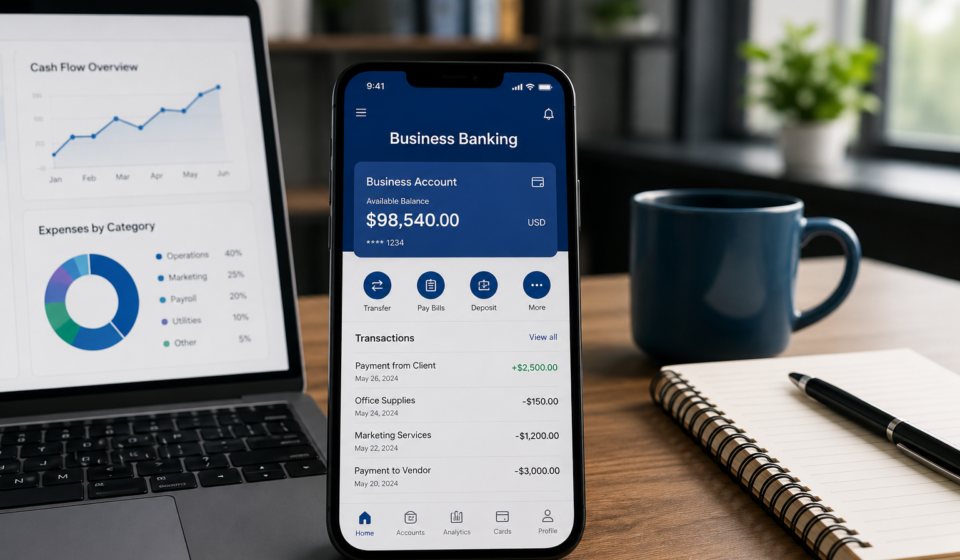
Modern digital solutions provide dashboards showing:
- Income trends
- Monthly spending
- Cash flow summaries
- Customer payments
- Business expenses
Visual reports make complex financial information much easier to understand.
Rather than reviewing lengthy spreadsheets, owners can quickly identify spending patterns and opportunities for cost reduction.
Increased Convenience
Traditional banking required businesses to operate according to bank opening hours.
Today’s entrepreneurs expect 24/7 access.
A banking app allows business owners to manage finances whether they are:
- Traveling
- Meeting clients
- Working remotely
- Visiting suppliers
- Operating from home
This flexibility improves productivity and supports modern business operations.
Enhanced Security Features
Security has become one of the highest priorities in digital finance.
Modern banking platforms include advanced protection such as:
- Multi-factor authentication
- Biometric login
- Face recognition
- Fingerprint authentication
- End-to-end encryption
- Fraud monitoring
- Device verification
These technologies help reduce unauthorized access while protecting sensitive business information.
Although cyber threats continue evolving, security systems are becoming increasingly sophisticated to defend business accounts.
Automation Reduces Administrative Work
One of the biggest advantages of digital banking is automation. Many repetitive financial tasks that once required manual effort can now be completed automatically.
Examples include:
- Scheduled bill payments
- Automatic payroll processing
- Recurring supplier payments
- Expense categorization
- Monthly account statements
- Savings transfers
Automation minimizes human error while saving valuable time for business owners and finance teams.
Instead of spending hours each week processing routine transactions, entrepreneurs can focus on business development, customer relationships, and strategic planning.
Easier Payroll Management
Payroll is one of the most important financial responsibilities for any small business.
Employees expect accurate and timely payments, while employers must ensure compliance with tax regulations and employment laws.
Many digital financial platforms integrate payroll services, allowing businesses to:
- Pay employees on schedule
- Manage direct deposits
- Record payroll expenses
- Track salary history
- Generate payroll reports
These features reduce paperwork and improve payroll accuracy, especially for businesses with growing teams.
Simplified Tax Preparation
Tax season can be stressful for small business owners.
Organizing receipts, invoices, and expense records manually often takes considerable time.
Digital banking platforms simplify tax preparation by automatically recording financial transactions throughout the year.
Business owners can quickly access:
- Income summaries
- Expense reports
- Transaction history
- Payment records
- Downloadable account statements
Accurate financial records make it easier for accountants to prepare tax returns while reducing the likelihood of reporting errors.
Better Integration with Business Software
Modern businesses rely on multiple software solutions to manage operations.
Many financial platforms integrate seamlessly with:
- Accounting software
- Inventory management systems
- Payroll platforms
- E-commerce websites
- Customer relationship management (CRM) software
- Expense management tools
These integrations eliminate duplicate data entry and ensure that financial information remains consistent across different business systems.
This connected ecosystem improves productivity while reducing administrative workloads.
Faster Access to Business Financing
Access to capital is essential for business growth.
Whether purchasing equipment, expanding operations, or hiring additional staff, businesses often require financing.
Digital financial services have simplified loan applications by allowing businesses to:
- Apply online
- Upload documents electronically
- Track application status
- Receive quicker approval decisions
Some providers even analyze transaction history to assess financial health, helping qualified businesses receive funding more efficiently than through traditional methods.
Supporting Remote and Hybrid Work
Remote work has become increasingly common for businesses of all sizes.
Business owners and employees no longer need to work from the same location to manage company finances.
Using secure cloud-based services, authorized users can:
- Approve payments
- Review account balances
- Monitor expenses
- Access financial reports
- Authorize transactions
This flexibility supports remote teams while maintaining financial control.
Helping Businesses Make Better Financial Decisions
Successful financial management depends on accurate information.
Modern digital platforms provide business owners with valuable insights into their financial performance.
These insights include:
- Spending trends
- Revenue growth
- Seasonal sales patterns
- Cash flow analysis
- Budget comparisons
Rather than relying on assumptions, businesses can make informed decisions based on real financial data.
Better information often leads to smarter investments and improved long-term profitability.
Supporting International Business
Many small businesses now serve customers worldwide.
International transactions once involved complicated banking procedures, high fees, and long processing times.
Digital financial solutions have simplified cross-border business by offering:
- International transfers
- Multi-currency support
- Foreign exchange services
- Online payment acceptance
- Global transaction tracking
These capabilities help businesses expand into international markets with greater confidence.
Reducing Operating Costs
Cost control is essential for every small business.
Traditional banking often involves expenses such as:
- Branch visits
- Paper statements
- Manual processing fees
- Administrative labor
- Printing financial documents
Digital banking reduces many of these costs through automation and online services.
Lower operating expenses improve profitability while allowing businesses to allocate resources toward growth initiatives.
Improving Customer Experience
Customers increasingly expect fast and convenient payment options.
Businesses that provide flexible payment methods often enjoy higher customer satisfaction.
Modern financial platforms enable businesses to:
- Accept digital payments
- Process refunds quickly
- Send payment requests
- Receive instant payment notifications
A smooth payment experience strengthens customer trust and encourages repeat business.
Challenges Small Businesses Should Consider
Despite numerous benefits, digital financial management also presents certain challenges.
Business owners should carefully evaluate potential risks before selecting a financial platform.
Some common concerns include:
Cybersecurity Risks
Cybercriminals continue developing increasingly sophisticated attacks.
Businesses must protect their financial information by:
- Using strong passwords
- Enabling multi-factor authentication
- Updating software regularly
- Training employees about phishing attacks
Security awareness remains one of the most effective defenses against cyber threats.
Internet Dependence
Digital banking requires a reliable internet connection.
Businesses operating in areas with unstable internet access may occasionally experience delays in completing transactions.
Having backup internet options can reduce disruption during outages.
Learning New Technology
Some business owners may initially find digital platforms unfamiliar.
Fortunately, most providers now design their applications with user-friendly interfaces, guided tutorials, and customer support resources to simplify adoption.
Training employees early helps ensure smoother implementation.
Privacy Concerns
Businesses share significant amounts of financial data with digital service providers.
Before choosing any platform, owners should review:
- Privacy policies
- Data encryption standards
- Security certifications
- Regulatory compliance
Working with reputable financial institutions helps reduce privacy risks.
Best Practices for Safe Digital Banking
To maximize security and efficiency, businesses should follow several best practices.
These include:
- Use strong, unique passwords.
- Enable biometric authentication whenever possible.
- Activate two-factor authentication.
- Monitor transactions regularly.
- Update devices and applications promptly.
- Limit account access based on employee responsibilities.
- Back up important financial records securely.
- Avoid accessing financial accounts through public Wi-Fi networks.
These simple habits significantly reduce the likelihood of fraud and unauthorized account access.
Why Adoption Continues to Grow
The popularity of the banking app continues to increase because businesses recognize its ability to simplify financial management while improving operational efficiency.
Instead of treating digital banking as merely a convenience, many entrepreneurs now consider it an essential business tool.
From startups to established companies, organizations are embracing mobile financial technology to remain competitive in today’s fast-moving digital economy.
Future Trends in Digital Business Banking
Digital finance continues to evolve at an impressive pace. As technology advances, banking services will become even more intelligent, personalized, and efficient for small businesses.
Several emerging trends are expected to shape the future of business finance.
Artificial Intelligence
Artificial Intelligence (AI) is becoming a major part of financial management.
AI-powered systems can help businesses by:
- Predicting future cash flow
- Detecting suspicious transactions
- Identifying unusual spending patterns
- Providing personalized financial recommendations
- Automating customer support
These capabilities enable business owners to make faster and better-informed financial decisions.
Open Banking
Open banking allows approved financial providers to securely share banking data with customer permission.
For small businesses, this means:
- Better financial insights
- Easier loan applications
- Improved budgeting tools
- More personalized banking services
- Greater competition among financial providers
Open banking encourages innovation while giving businesses more control over their financial information.
Embedded Finance
Embedded finance is becoming increasingly popular.
Instead of switching between multiple applications, businesses can access financial services directly within the software they already use.
Examples include:
- Accounting software offering business loans
- E-commerce platforms providing payment processing
- Inventory systems integrating supplier payments
- Payroll software handling employee banking
This creates a smoother workflow while reducing administrative effort.
Digital Wallet Integration
Many businesses now accept digital wallet payments because customers expect faster checkout experiences.
Future banking solutions will provide even stronger integration with:
- Mobile wallets
- Contactless payments
- QR code transactions
- Online payment gateways
This flexibility supports businesses operating both online and in physical locations.
Stronger Fraud Detection
Cybersecurity technology continues improving every year.
Future banking platforms are expected to include:
- AI-powered fraud detection
- Behavioral authentication
- Continuous identity verification
- Real-time transaction monitoring
- Advanced biometric security
These innovations will provide greater protection against increasingly sophisticated cyber threats.
How to Choose the Right Banking Solution
Every business has unique financial requirements.
Before selecting a digital banking platform, business owners should evaluate several important factors.
Security
Choose providers that offer:
- Multi-factor authentication
- Data encryption
- Fraud monitoring
- Secure login methods
- Regulatory compliance
Security should always be the highest priority.
Ease of Use
An intuitive interface helps employees complete financial tasks efficiently.
Look for platforms with:
- Simple navigation
- Clear dashboards
- Mobile accessibility
- Easy transaction management
Complicated systems often reduce productivity rather than improve it.
Business Features
Different businesses require different financial tools.
Consider whether the platform supports:
- Payroll
- Expense tracking
- Invoice management
- International payments
- Accounting integration
- Multi-user access
Selecting features that match your operations will maximize long-term value.
Customer Support
Reliable customer service becomes especially important when financial issues arise.
Look for providers offering:
- Live chat
- Telephone support
- Email assistance
- Knowledge bases
- Fast response times
Quick support minimizes business disruption during technical problems.
Transparent Fees
Businesses should always understand the full cost of financial services.
Review:
- Monthly subscription fees
- Transaction charges
- International transfer costs
- ATM fees
- Currency conversion charges
Transparent pricing helps avoid unexpected expenses.
Frequently Asked Questions
Are banking apps safe for small businesses?
Yes. Most reputable financial institutions use encryption, biometric authentication, fraud monitoring, and multi-factor authentication to protect business accounts. Businesses should also follow good cybersecurity practices.
Can small businesses manage payroll through digital banking?
Many financial providers now integrate payroll services, allowing businesses to pay employees, manage direct deposits, and track payroll expenses from one platform.
Do banking apps help improve cash flow?
Yes. Real-time transaction monitoring, payment reminders, expense tracking, and financial dashboards provide better visibility into available funds and upcoming payments.
Are digital banking services suitable for startups?
Absolutely. Startups often benefit from lower administrative costs, faster financial management, automated payments, and easy access to financial information.
Can businesses make international payments?
Most modern business banking platforms support international transfers, foreign currency payments, and global payment tracking, making international business much easier.
Conclusion
Technology has fundamentally changed how small businesses manage their finances. Tasks that once required paperwork, branch visits, and manual processing can now be completed within minutes through secure digital platforms.
A modern banking app provides far more than simple account access. It supports payroll, expense management, invoicing, budgeting, cash flow monitoring, financial reporting, security, and business growth. By reducing administrative work and providing real-time financial insights, these applications allow entrepreneurs to focus on what matters most—building successful businesses.
As artificial intelligence, automation, open banking, and advanced cybersecurity continue evolving, digital financial services will become even more powerful. Small businesses that embrace these innovations today will be better prepared to compete in an increasingly digital economy.
For entrepreneurs looking to improve efficiency, reduce costs, and strengthen financial decision-making, adopting modern digital banking solutions is no longer just an option—it is a strategic investment in long-term business success.



[…] How Banking Apps Are Transforming Small Business Finance […]