
Introduction
In today’s fast-moving financial world, investors expect more than simply knowing whether their portfolio has gained or lost value. They want detailed insights into how their investments are performing, why returns differ from market benchmarks, and whether their investment strategy is delivering the expected results. This is where investment performance services play an essential role.
Whether you are an individual investor, a financial adviser, an asset management company, a pension fund, or an institutional investor, measuring investment performance accurately is crucial for making informed financial decisions. Modern investment portfolios often contain a wide variety of assets, including equities, bonds, mutual funds, exchange-traded funds (ETFs), alternative investments, and international securities. Tracking the performance of these investments manually is not only time-consuming but also prone to errors.
Investment performance services provide sophisticated tools, analytics, reporting systems, and benchmarking capabilities that help investors understand portfolio returns in greater depth. These services transform complex financial data into meaningful insights, enabling investors to evaluate strategies, identify risks, improve portfolio management, and maintain transparency with stakeholders.
As financial regulations continue to evolve and investors demand greater accountability, performance measurement has become an integral part of wealth management. This guide explores what investment performance services are, how they work, their essential features, and why they have become indispensable in today’s investment landscape.
What Are Investment Performance Services?
Investment performance services refer to professional solutions that calculate, analyse, monitor, and report how investment portfolios perform over time. These services compare portfolio returns against benchmarks while evaluating the effectiveness of investment decisions.
Rather than simply reporting gains and losses, performance services provide detailed metrics that explain:
- Portfolio returns
- Risk-adjusted performance
- Benchmark comparisons
- Asset allocation effectiveness
- Investment attribution
- Historical trends
- Manager performance
- Compliance reporting
These services are widely used across the financial industry by:
- Wealth management firms
- Investment advisers
- Pension funds
- Insurance companies
- Family offices
- Asset managers
- Banks
- Institutional investors
Instead of relying solely on spreadsheets, organisations use specialised software platforms capable of processing thousands—or even millions—of transactions while maintaining accuracy and regulatory compliance.
Why Investment Performance Measurement Matters
Investment decisions should always be based on reliable data rather than assumptions.
Without proper performance measurement, investors cannot determine:
- Whether their strategy is successful
- If their portfolio is outperforming the market
- Which assets generate the strongest returns
- Which investments increase portfolio risk
- Whether investment managers add genuine value
For example, a portfolio may return 10% over one year.
At first glance, that appears impressive.
However, if the benchmark returned 15%, the portfolio actually underperformed.
Likewise, if the portfolio achieved 10% while taking excessive risk compared to competitors, the result may not be as attractive as it initially seems.
Performance measurement provides the context needed to interpret investment returns accurately.
How Investment Performance Services Work
Professional investment performance systems gather data from multiple financial sources before performing complex calculations.
The process generally follows several stages.
Data Collection
Investment information is gathered from:
- Brokerage accounts
- Custodian banks
- Trading systems
- Portfolio management software
- Market data providers
- Accounting systems
Accurate data collection forms the foundation of reliable reporting.
Data Validation
Financial data often contains inconsistencies.
Performance systems automatically identify issues such as:
- Missing transactions
- Duplicate records
- Incorrect pricing
- Currency mismatches
- Settlement errors
Data validation ensures that reports remain trustworthy.
Performance Calculation
Once the information is verified, specialised algorithms calculate returns using recognised financial methodologies.
Common calculations include:
- Time-weighted return (TWR)
- Money-weighted return (MWR)
- Internal rate of return (IRR)
- Annualised returns
- Cumulative returns
Each method serves different reporting purposes depending on investor requirements.
Benchmark Comparison
Performance alone tells only part of the story.
Professional reports compare portfolios against benchmarks such as:
- Market indices
- Sector averages
- Custom benchmarks
- Peer groups
Benchmarking helps investors determine whether their strategy is outperforming or underperforming similar investments.
Reporting
Finally, the system produces reports designed for various audiences.
Reports may include:
- Executive summaries
- Client reports
- Regulatory reports
- Institutional reports
- Quarterly performance reviews
- Annual investment reports
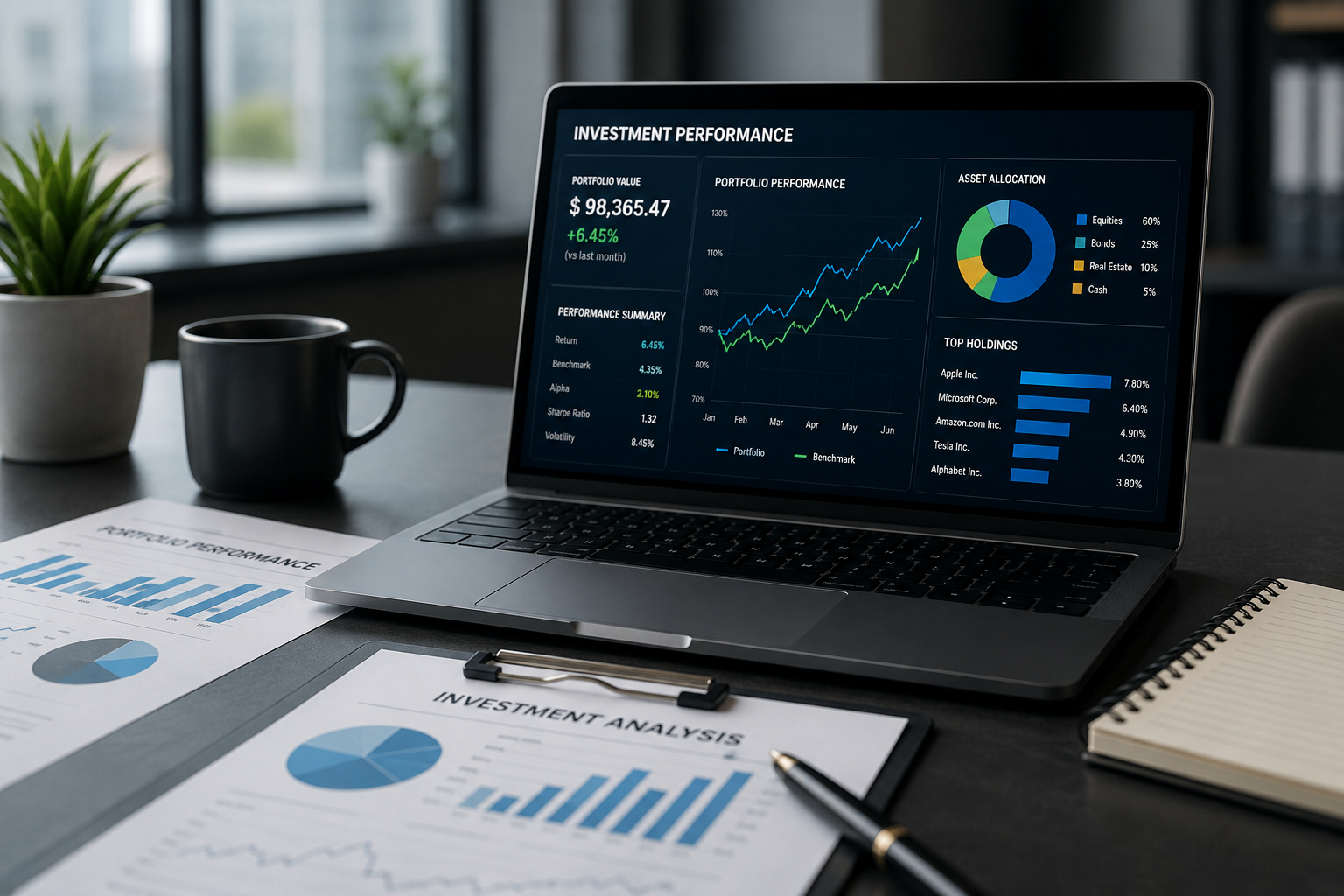
Many platforms now provide interactive dashboards with real-time performance updates.
Core Features of Investment Performance Services
Modern performance platforms offer a broad range of sophisticated capabilities designed to improve investment analysis.
Comprehensive Portfolio Analysis
One of the biggest strengths of investment performance services is their ability to analyse portfolios across multiple dimensions.
Instead of viewing only total returns, investors can evaluate:
- Individual securities
- Asset classes
- Geographic regions
- Investment sectors
- Portfolio diversification
- Currency exposure
This detailed analysis supports better decision-making.
Benchmark Tracking
Benchmark comparison remains one of the most valuable features.
Popular benchmarks include:
- Global equity indices
- Bond indices
- Sector-specific indices
- Balanced portfolio benchmarks
- Custom institutional benchmarks
By comparing results against these standards, investors gain a clearer understanding of performance quality rather than focusing solely on absolute returns.
Performance Attribution Analysis
Attribution analysis explains why a portfolio achieved certain returns.
It separates performance into factors such as:
- Security selection
- Asset allocation
- Market timing
- Currency decisions
- Sector exposure
This allows investment managers to identify strengths and weaknesses within their strategies.
Risk Measurement
Return alone does not tell the complete investment story.
Professional performance systems also evaluate risk using measurements including:
- Standard deviation
- Volatility
- Beta
- Sharpe Ratio
- Tracking error
- Maximum drawdown
Risk-adjusted performance provides a more balanced picture of investment success.
Multi-Currency Support
Global investors frequently hold investments denominated in multiple currencies.
Performance systems automatically manage:
- Currency conversions
- Exchange rate fluctuations
- Foreign investment reporting
- International benchmarks
This improves reporting accuracy for global portfolios.
Historical Performance Analysis
Historical reporting enables investors to evaluate long-term investment consistency.
Reports often include:
- One-month returns
- Quarterly returns
- Annual performance
- Five-year history
- Ten-year performance
- Since-inception returns
Long-term data helps distinguish sustainable strategies from short-term market fluctuations.
Custom Reporting
Different stakeholders require different information.
Modern platforms allow reports to be customised for:
- Individual clients
- Financial advisers
- Investment committees
- Institutional boards
- Regulators
- Senior executives
Custom branding and automated report generation further enhance efficiency.
Real-Time Dashboards
Many investment firms now rely on cloud-based dashboards that display:
- Live portfolio values
- Daily returns
- Benchmark performance
- Asset allocation
- Risk metrics
- Investment trends
Real-time access enables quicker decision-making in changing market conditions.
Integration with Other Financial Systems
Investment performance platforms often integrate seamlessly with:
- Portfolio management systems
- Accounting software
- CRM platforms
- Custodian services
- Trading platforms
- Compliance systems
Integration reduces manual work while improving operational efficiency.
Security and Compliance
Because investment data is highly sensitive, leading providers implement robust security measures, including:
- Data encryption
- Multi-factor authentication
- User access controls
- Audit trails
- Secure cloud infrastructure
- Regulatory compliance features
These safeguards help protect confidential financial information while meeting industry standards.
Benefits of Investment Performance Services
As investment portfolios become increasingly diversified and complex, accurate performance measurement has become essential rather than optional. Investors and financial professionals rely on detailed reporting to understand not only how much they have earned but also how those returns compare with expectations and market benchmarks.
Below are some of the most significant benefits these services provide.
Better Investment Decisions
Reliable performance data helps investors make informed decisions based on facts instead of assumptions.
By analysing historical returns, asset allocation, and benchmark comparisons, investors can determine:
- Which investments consistently perform well
- Which assets should be reduced or replaced
- Whether portfolio diversification is effective
- If investment objectives are being achieved
This information supports smarter long-term planning.
Greater Transparency
Transparency builds trust between investment managers and clients.
Professional reports clearly explain:
- Portfolio returns
- Fees and expenses
- Market comparisons
- Risk exposure
- Portfolio changes
Clear reporting helps clients understand exactly how their money is being managed.
Improved Risk Management
Every investment carries some level of risk.
Performance reporting enables investors to identify:
- Overexposure to specific sectors
- High portfolio volatility
- Concentration risks
- Currency risks
- Liquidity concerns
Understanding these risks allows investors to make adjustments before problems become significant.
Accurate Benchmark Comparisons
Simply earning positive returns does not always indicate success.
For example:
- A portfolio returning 8% may appear successful.
- However, if its benchmark gained 14%, the portfolio underperformed.
Performance measurement provides valuable context by comparing returns against relevant market indices and peer groups.
Increased Operational Efficiency
Without specialised software, performance reporting often requires manual calculations using spreadsheets.
Modern platforms automate:
- Return calculations
- Report generation
- Data validation
- Portfolio reconciliation
- Benchmark updates
Automation reduces errors while saving significant time for investment teams.
Enhanced Client Reporting
Clients increasingly expect professional, easy-to-understand reports.
Modern reporting systems include:
- Interactive dashboards
- Visual performance charts
- Historical trend analysis
- Quarterly summaries
- Personalised reporting
Well-designed reports strengthen client relationships and improve communication.
Regulatory Compliance
Financial regulations continue to become more demanding.
Professional performance systems help organisations comply with industry standards by maintaining:
- Accurate records
- Audit trails
- Historical calculations
- Standardised methodologies
- Consistent reporting practices
Compliance reduces regulatory risks while improving operational credibility.
Who Uses Investment Performance Services?
These services benefit a wide range of financial organisations.
Wealth Management Firms
Advisers use performance reporting to demonstrate value to clients while reviewing investment strategies.
Asset Management Companies
Fund managers analyse portfolio performance to improve investment decisions and satisfy institutional investors.
Pension Funds
Large retirement funds manage billions in assets.
Performance measurement ensures beneficiaries receive accurate reporting on fund performance.
Banks
Private banking divisions use performance reporting to monitor high-net-worth investment portfolios.
Insurance Companies
Insurance firms invest significant capital reserves.
Performance measurement helps optimise investment strategies while managing long-term liabilities.
Family Offices
Family offices oversee substantial private wealth.
Professional reporting enables multiple generations of investors to monitor assets effectively.
Institutional Investors
Universities, charities, foundations, and sovereign wealth funds all depend on accurate investment reporting to meet governance requirements.
Challenges in Investment Performance Measurement
Although modern software has transformed portfolio analysis, performance measurement still presents several challenges.
Data Quality
Even the most advanced software cannot produce reliable reports using inaccurate information.
Common issues include:
- Missing transactions
- Incorrect pricing
- Delayed market data
- Duplicate records
- Currency inconsistencies
Maintaining clean data remains essential.
Multiple Asset Classes
Today’s portfolios often include:
- Stocks
- Bonds
- Property
- Infrastructure
- Commodities
- Hedge funds
- Private equity
- Cryptocurrencies
Each asset class has different valuation methods, increasing reporting complexity.
International Investments
Global portfolios introduce additional considerations such as:
- Exchange rate fluctuations
- Different market holidays
- Local regulations
- Foreign tax treatments
- International accounting standards
Professional systems must account for these variables.
Benchmark Selection
Choosing the wrong benchmark can lead to misleading conclusions.
A global equity portfolio should not be compared against a domestic index alone.
Appropriate benchmarks ensure fair and meaningful performance evaluation.
Changing Regulations
Financial reporting requirements continue to evolve.
Performance providers must regularly update their systems to remain compliant with changing regulations and industry standards.
Best Practices for Investment Performance Reporting
Following recognised best practices improves reporting accuracy and investor confidence.
Use Reliable Data Sources
Always obtain market prices, transaction records, and benchmark information from trusted financial providers.
Accurate input produces reliable output.
Standardise Calculation Methods
Using consistent methodologies ensures fair comparisons over time.
Industry-standard calculations improve credibility across different reporting periods.
Review Reports Regularly
Performance reporting should not be limited to year-end reviews.
Most organisations conduct:
- Monthly reviews
- Quarterly reports
- Annual performance assessments
Frequent reviews allow investors to identify issues early.
Focus on Long-Term Performance
Short-term market fluctuations can be misleading.
Evaluating performance over several years provides a clearer picture of investment quality.
Combine Return and Risk Analysis
High returns achieved through excessive risk may not represent strong investment management.
Always consider:
- Volatility
- Drawdowns
- Risk-adjusted returns
- Portfolio diversification
A balanced approach provides a more accurate assessment.
Use Visual Reporting
Charts and graphs make complex financial information easier to understand.
Common visual tools include:
- Performance trend lines
- Asset allocation charts
- Risk-return scatter plots
- Benchmark comparison graphs
Visual reporting improves communication with clients and stakeholders.
Automate Reporting Where Possible
Automation reduces manual errors while improving consistency.
Many firms schedule automatic:
- Daily calculations
- Weekly summaries
- Monthly reports
- Quarterly client statements
Automation also allows investment professionals to focus on analysis rather than administration.
The Role of Technology in Modern Performance Services
Technology has significantly improved the speed, accuracy, and accessibility of performance reporting.
Cloud computing enables investors to access portfolio information from anywhere, while artificial intelligence helps identify trends and anomalies in large datasets. Machine learning models can analyse historical data to highlight patterns, automate routine tasks, and support better forecasting.
Many platforms now include interactive dashboards, mobile access, and advanced visualisations, making complex financial information easier to understand. These innovations allow investors to monitor performance more efficiently and respond quickly to changing market conditions.
How to Choose the Right Investment Performance Service Provider
Selecting the right provider is a critical decision for any investor or financial organisation. A reliable service should do more than calculate returns—it should provide accurate data, meaningful insights, and reporting tools that support better decision-making.
When evaluating providers, consider the following factors:
Accuracy and Reliability
The quality of any performance report depends on the accuracy of the underlying data. Choose a provider with a proven track record of delivering precise calculations and maintaining robust data validation processes.
Comprehensive Reporting
Look for platforms that offer a variety of report formats, including:
- Portfolio summaries
- Benchmark comparisons
- Risk analysis
- Performance attribution
- Asset allocation reports
- Custom client reports
Flexible reporting ensures different stakeholders receive information in a format that suits their needs.
Ease of Use
An intuitive interface can save valuable time. Dashboards should be easy to navigate, allowing users to access key metrics without extensive training.
Integration Capabilities
The best platforms integrate seamlessly with:
- Portfolio management software
- Accounting systems
- Custodian banks
- CRM solutions
- Trading platforms
Integration reduces manual data entry and minimises operational errors.
Data Security
Financial information is highly sensitive, making security a top priority. Ensure the provider offers:
- Data encryption
- Multi-factor authentication
- Secure cloud storage
- Regular backups
- Access controls
- Audit logs
Strong security measures protect both clients and organisations.
Customer Support
Reliable technical support is essential, particularly during reporting periods or system updates. Providers offering responsive customer service and training resources can significantly improve the user experience.
Future Trends in Investment Performance Services
The financial services industry continues to evolve rapidly. Several emerging trends are shaping the future of performance measurement.
Artificial Intelligence and Machine Learning
AI-powered analytics are becoming increasingly common. These technologies can:
- Detect unusual portfolio behaviour
- Identify performance trends
- Improve forecasting
- Automate report generation
- Reduce manual analysis
As AI capabilities continue to improve, investors can expect more intelligent and personalised insights.
Real-Time Portfolio Monitoring
Investors no longer want to wait until the end of the month to review performance.
Real-time reporting allows users to:
- Monitor portfolio values instantly
- Track market movements
- Review risk exposure
- Compare benchmark performance
- Respond quickly to market changes
This level of accessibility supports faster and more informed decision-making.
ESG Performance Reporting
Environmental, Social, and Governance (ESG) investing has become an important consideration for many investors.
Modern reporting platforms increasingly include ESG metrics that evaluate how investments align with sustainability goals. This enables investors to balance financial performance with broader ethical and environmental objectives.
Cloud-Based Solutions
Cloud technology has transformed investment reporting by offering:
- Remote access
- Automatic software updates
- Enhanced collaboration
- Lower infrastructure costs
- Improved scalability
Cloud-based platforms also make it easier for organisations with multiple offices to access consistent, up-to-date information.
Enhanced Data Visualisation
Advanced charts, dashboards, and interactive reports help users understand complex financial data more quickly.
Instead of reading lengthy tables, investors can identify trends through visual tools such as:
- Heat maps
- Interactive graphs
- Performance timelines
- Allocation charts
- Risk dashboards
These features improve communication and support better strategic planning.
Frequently Asked Questions
What are investment performance services?
Investment performance services are professional solutions that measure, analyse, and report the returns and effectiveness of investment portfolios. They help investors evaluate portfolio performance, compare results with benchmarks, assess risk, and make informed financial decisions.
Why are benchmark comparisons important?
Benchmarks provide context for investment returns. They help determine whether a portfolio is outperforming or underperforming the broader market or a comparable investment strategy.
Who benefits from these services?
Individual investors, wealth managers, pension funds, banks, insurance companies, family offices, and institutional investors all benefit from accurate performance reporting and portfolio analysis.
How often should performance be reviewed?
Most financial professionals recommend reviewing investment performance monthly or quarterly, with a more comprehensive annual assessment to evaluate long-term progress and strategic goals.
Can small investors use performance reporting tools?
Yes. Many modern platforms offer affordable solutions designed for individual investors and small advisory firms, making professional performance analysis more accessible than ever.
Conclusion
Measuring investment success requires far more than checking whether a portfolio has increased in value. Investors need reliable data, meaningful analysis, and clear reporting to understand how their investments are performing and whether their strategies are achieving the desired outcomes.
Professional investment performance services provide these capabilities by combining advanced analytics, benchmark comparisons, risk assessment, and automated reporting into a single, comprehensive solution. They enable investors to make evidence-based decisions, improve portfolio management, enhance transparency, and meet regulatory requirements with confidence.
As financial markets continue to evolve, technology will play an even greater role in performance measurement. Artificial intelligence, cloud computing, real-time analytics, and enhanced visual reporting are making performance management faster, more accurate, and more accessible than ever before.
Whether you are an individual building long-term wealth or an institution managing complex portfolios, investing in robust performance measurement tools is an important step towards achieving sustainable financial success. By following best practices, selecting the right provider, and regularly reviewing results, investors can gain deeper insights, reduce risk, and make smarter decisions for the future.



[…] most importantly, July provided investors with updated information that will influence investment strategies during the remainder of […]