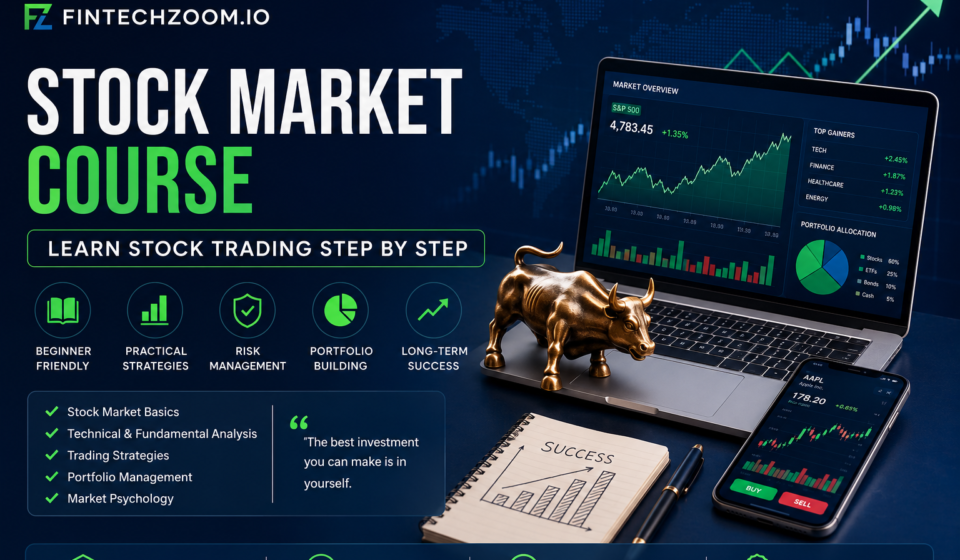

The stock market has become one of the most popular ways to build long-term wealth, generate passive income, and diversify investments. However, successful investing requires more than simply buying shares. Understanding market trends, analyzing companies, managing risk, and developing a disciplined strategy are essential skills for every investor. This is why many beginners look for structured educational resources before entering the market.
The fintechzoom.io stock market course is designed to help aspiring investors learn the fundamentals of stock trading through a step-by-step approach. Rather than relying on scattered online articles or social media advice, learners can follow an organized path that covers essential concepts, practical strategies, and risk management techniques. Whether you’re completely new to investing or looking to improve your existing knowledge, a structured course can make the learning process more efficient and easier to understand.
In this comprehensive guide, we’ll explore what the fintechzoom.io stock market course offers, who it is designed for, the topics typically covered, and how it can help you build confidence in stock market investing.
What Is the FintechZoom.io Stock Market Course?
The fintechzoom.io stock market course is an educational resource focused on teaching individuals how the stock market works and how to make informed investment decisions. Instead of encouraging speculation or quick-profit strategies, the course emphasizes understanding market fundamentals, investment principles, technical and fundamental analysis, portfolio management, and disciplined decision-making.
The goal is to help learners develop the skills needed to evaluate investment opportunities, understand financial markets, and manage risk effectively. By following a structured curriculum, students can gradually progress from beginner-level concepts to more advanced trading and investing techniques.
Unlike random tutorials found online, a dedicated course organizes learning into logical modules, allowing students to build knowledge step by step.
Why Learn Stock Trading Through a Structured Course?
Many beginners make the mistake of investing without understanding how the stock market actually functions. This often leads to emotional decisions, unnecessary risks, and financial losses.
A structured stock market course provides several advantages:
- Builds a strong foundation in investing principles
- Explains financial terminology in simple language
- Introduces proven trading and investment strategies
- Encourages disciplined risk management
- Helps learners avoid common beginner mistakes
- Develops confidence before investing real money
Learning systematically is often more effective than relying solely on videos, forums, or social media posts.
Who Should Take the Course?
The course is suitable for a wide range of learners interested in financial markets.
Ideal Participants Include:
- Complete beginners with no investing experience
- College and university students
- Working professionals
- Small business owners
- Long-term investors
- Part-time traders
- Individuals planning for retirement
- Anyone interested in personal finance
No advanced financial background is typically required to begin learning.
Skills You Can Develop
The course focuses on practical investing knowledge that learners can apply over time.
| Learning Area | Skills Developed |
| Stock Market Basics | Understanding exchanges, shares, and market operations |
| Fundamental Analysis | Evaluating company financial performance |
| Technical Analysis | Reading price charts and identifying trends |
| Portfolio Management | Building diversified investment portfolios |
| Risk Management | Limiting investment losses |
| Trading Psychology | Managing emotions and discipline |
| Investment Planning | Setting financial goals and strategies |
These skills help create a balanced understanding of how investing works rather than focusing on short-term speculation.
What You Can Expect to Learn
A well-designed stock market course generally begins with the fundamentals before introducing more advanced topics.
Typical lessons include:
Introduction to Financial Markets
Students first learn how stock markets operate and why companies issue shares.
Topics include:
- What stocks represent
- Public companies
- Stock exchanges
- Market participants
- Initial Public Offerings (IPOs)
- Market capitalization
Understanding these concepts creates a strong foundation for future lessons.
Understanding Different Types of Investments
Successful investors understand that stocks are only one part of the financial markets.
The course may also introduce:
- Exchange-Traded Funds (ETFs)
- Mutual funds
- Index funds
- Bonds
- Dividend-paying stocks
- Growth stocks
- Value stocks
Learning the differences helps investors choose investments that align with their financial goals.
How Stock Prices Move
One of the most important topics for beginners is understanding why stock prices rise and fall.
Students typically learn about:
- Supply and demand
- Corporate earnings
- Economic news
- Interest rates
- Inflation
- Investor sentiment
- Industry performance
Rather than reacting emotionally to price changes, learners begin understanding the factors influencing market movements.
Fundamental Analysis
Fundamental analysis helps investors evaluate whether a company is financially healthy.
Important concepts include:
- Revenue
- Net income
- Earnings per share (EPS)
- Profit margins
- Debt levels
- Cash flow
- Return on equity
These financial metrics allow investors to compare companies and make informed investment decisions instead of relying on speculation.
Technical Analysis Basics
Many traders use price charts to identify trends and potential buying or selling opportunities.
The course often introduces beginners to:
- Candlestick charts
- Trend lines
- Support levels
- Resistance levels
- Moving averages
- Volume analysis
- Basic chart patterns
While technical analysis should not be the only factor influencing investment decisions, it can provide valuable market insights when combined with fundamental research.
Course Modules Overview
The following table illustrates how a structured learning path may progress.
| Module | Main Focus | Learning Outcome |
| Module 1 | Stock Market Basics | Understand how financial markets work |
| Module 2 | Investment Fundamentals | Learn key investing concepts |
| Module 3 | Fundamental Analysis | Evaluate company performance |
| Module 4 | Technical Analysis | Interpret stock price charts |
| Module 5 | Risk Management | Protect investment capital |
| Module 6 | Portfolio Building | Create a diversified investment strategy |
| Module 7 | Trading Psychology | Improve decision-making discipline |
| Module 8 | Long-Term Investing | Develop sustainable investment habits |
Following these modules step by step allows learners to build knowledge progressively rather than feeling overwhelmed by complex financial concepts.
Risk Management: The Foundation of Successful Investing
One of the most valuable lessons in the fintechzoom.io stock market course is that protecting your capital is just as important as earning profits. Many beginners focus only on potential returns while ignoring the risks involved in stock market investing.
Risk management teaches investors how to reduce losses and make informed decisions instead of emotional ones.
Key risk management principles include:
- Never invest money you cannot afford to lose.
- Diversify your portfolio across multiple sectors.
- Avoid investing your entire capital in a single stock.
- Set realistic financial goals.
- Review your investments regularly.
- Maintain a long-term perspective.
Understanding these principles can help investors remain disciplined during periods of market volatility.
Portfolio Diversification
Diversification is a strategy used to spread investment risk across different assets. Rather than relying on a single company or industry, investors build a balanced portfolio that includes multiple sectors.
Example of a Diversified Portfolio
| Investment Type | Example Allocation |
| Technology Stocks | 30% |
| Healthcare Stocks | 20% |
| Financial Stocks | 15% |
| Consumer Goods | 15% |
| ETFs | 15% |
| Cash Reserve | 5% |
Diversification reduces the impact of poor performance from any single investment and helps create a more stable portfolio over time.
Understanding Investment Strategies
The course introduces different investing approaches so learners can choose a strategy that aligns with their financial goals and risk tolerance.
Long-Term Investing
Long-term investors purchase quality companies and hold them for several years. This strategy focuses on business growth, dividends, and compounding returns rather than short-term price fluctuations.
Swing Trading
Swing traders aim to capture medium-term price movements that may last from a few days to several weeks. They often use technical analysis to identify trading opportunities.
Position Trading
Position trading involves holding investments for months or even years based on long-term market trends and company performance.
Dividend Investing
Dividend investors seek companies that regularly distribute a portion of their profits to shareholders, creating a potential source of passive income.
Fundamental Analysis vs. Technical Analysis
One of the most important lessons for beginners is understanding the difference between these two approaches.
| Fundamental Analysis | Technical Analysis |
| Examines company financials | Studies price charts |
| Focuses on business value | Focuses on market trends |
| Best for long-term investing | Commonly used for trading |
| Uses earnings reports | Uses chart patterns |
| Evaluates management quality | Evaluates price momentum |
Successful investors often combine both methods instead of relying exclusively on one.
Building an Investment Plan
A written investment plan helps maintain consistency and discipline.
A basic plan should include:
- Financial objectives
- Investment budget
- Preferred sectors
- Risk tolerance
- Investment timeline
- Portfolio review schedule
- Exit strategy
Having a structured plan reduces emotional decision-making during market fluctuations.
Understanding Market Cycles
Financial markets naturally move through different phases over time.
Bull Market
A bull market is characterized by rising stock prices, strong investor confidence, and economic growth.
Bear Market
A bear market occurs when stock prices decline significantly over an extended period. While challenging, bear markets can also present opportunities for long-term investors.
Market Correction
A correction is a temporary decline in stock prices, often following a period of rapid gains.
Recognizing these market cycles helps investors avoid panic selling and maintain a long-term perspective.
Importance of Trading Psychology
Emotions play a major role in investment decisions.
Common emotional mistakes include:
- Fear of missing out (FOMO)
- Panic selling during market declines
- Overconfidence after profitable trades
- Impatience with long-term investments
- Chasing trending stocks without research
The course emphasizes discipline, patience, and sticking to a well-defined investment strategy rather than reacting emotionally to daily market movements.
Practical Learning Experience
Many structured stock market courses include practical learning exercises that allow students to apply theoretical concepts before investing real money.
These activities may include:
- Market analysis exercises
- Stock research assignments
- Portfolio-building simulations
- Chart interpretation practice
- Financial statement analysis
- Risk assessment activities
Hands-on practice helps reinforce learning and improves confidence.
Common Beginner Mistakes
New investors often repeat the same avoidable mistakes.
| Mistake | Better Approach |
| Investing without research | Study the company before buying |
| Following social media hype | Conduct independent analysis |
| Putting all money into one stock | Diversify investments |
| Trading emotionally | Follow a written investment plan |
| Ignoring company fundamentals | Review financial statements |
| Trying to get rich quickly | Focus on long-term growth |
Learning to avoid these mistakes can significantly improve investment outcomes over time.
Benefits of Taking a Structured Stock Market Course
A well-organized learning program offers several advantages compared to self-directed learning.
Better Knowledge
Students gain a comprehensive understanding of investing principles rather than fragmented information.
Improved Confidence
Understanding how markets work helps reduce uncertainty and emotional decision-making.
Organized Learning Path
Lessons build progressively, allowing beginners to master one topic before moving to the next.
Practical Skills
Learners develop real-world skills such as stock analysis, portfolio construction, and risk management.
Long-Term Value
Investment education can benefit individuals throughout their financial journey by supporting informed decision-making.
Tips for Success While Learning Stock Trading
To maximize the value of the course:
- Study consistently instead of rushing through lessons.
- Practice analyzing companies regularly.
- Keep up with financial news and market developments.
- Maintain a long-term mindset.
- Review your investment goals periodically.
- Learn from both successful and unsuccessful investment decisions.
- Continue expanding your knowledge even after completing the course.
By combining structured education with ongoing practice, learners can build a strong foundation for making informed investment decisions and navigating the stock market with greater confidence.
How to Measure Your Learning Progress
Learning stock trading is an ongoing journey rather than a one-time achievement. The fintechzoom.io stock market course encourages learners to evaluate their progress regularly instead of focusing only on investment returns.
You can measure your development by asking yourself questions such as:
- Can I explain how the stock market works?
- Do I understand basic financial statements?
- Can I identify the difference between growth and value stocks?
- Am I able to manage investment risk?
- Do I have a clear investment strategy?
Tracking your knowledge and decision-making skills helps you identify areas for improvement before investing larger amounts of money.
Creating a Long-Term Investment Mindset
Many new investors expect quick profits, but successful investing usually requires patience and consistency.
A long-term mindset involves:
- Investing regularly
- Staying disciplined during market volatility
- Ignoring short-term market noise
- Reinvesting returns when appropriate
- Continuously improving financial knowledge
Building wealth often comes from making informed decisions consistently over many years rather than attempting to predict every market movement.
Advantages and Limitations
Before enrolling in any educational program, it’s important to understand both its strengths and its limitations.
| Advantages | Limitations |
| Structured learning path | Requires consistent study time |
| Beginner-friendly explanations | Learning alone doesn’t guarantee investment success |
| Covers essential investing concepts | Practical experience is still necessary |
| Focuses on risk management | Markets remain unpredictable |
| Encourages disciplined investing | Continuous learning is required |
| Builds confidence gradually | Individual results vary |
Understanding these points helps learners set realistic expectations and focus on developing long-term investing skills.
Best Practices After Completing the Course
Completing a stock market course is only the beginning. Continuous learning and practical experience are essential for becoming a confident investor.
Recommended next steps include:
Continue Researching Companies
Regularly review annual reports, quarterly earnings, and industry developments to strengthen your analytical skills.
Follow Financial News
Keeping up with economic events, interest rates, and corporate announcements helps you understand factors influencing stock prices.
Build a Watchlist
Create a list of companies you want to monitor. Observe their price movements, financial performance, and industry trends before making investment decisions.
Review Your Portfolio
Periodically evaluate your investments to ensure they remain aligned with your financial goals and risk tolerance.
Learn from Every Decision
Both profitable and unsuccessful investments provide valuable lessons. Keeping an investment journal can help you refine your strategy over time.
Who Can Benefit Most from the FintechZoom.io Stock Market Course?
The course is suitable for individuals with different financial goals and experience levels.
| Learner Type | Potential Benefits |
| Beginners | Learn investing fundamentals from scratch |
| Students | Develop financial literacy early |
| Working Professionals | Build long-term wealth alongside a career |
| Entrepreneurs | Improve understanding of financial markets |
| Retirement Planners | Learn strategies for long-term investing |
| Part-Time Investors | Gain structured knowledge without full-time commitment |
Its step-by-step format makes it accessible to learners who prefer a systematic approach to understanding the stock market.
Final Thoughts
The fintechzoom.io stock market course provides a structured pathway for individuals who want to understand investing before committing real money to the stock market. By covering market fundamentals, stock analysis, portfolio diversification, risk management, and investment psychology, the course helps learners build practical knowledge and confidence.
Rather than promoting unrealistic expectations of overnight success, the program emphasizes education, disciplined decision-making, and long-term financial planning. These principles are essential for anyone looking to become a more informed investor.
Whether your goal is to create passive income, prepare for retirement, or simply understand how financial markets work, investing in your financial education is one of the most valuable decisions you can make. With patience, consistent practice, and continuous learning, the knowledge gained through a structured course can support smarter investment decisions for years to come.
Frequently Asked Questions (FAQs)
1. What is the FintechZoom.io stock market course?
The fintechzoom.io stock market course is an educational program designed to teach beginners and aspiring investors the fundamentals of stock trading, investment strategies, risk management, and portfolio building through a structured learning approach.
2. Is the course suitable for complete beginners?
Yes. The course starts with basic stock market concepts before progressing to more advanced topics, making it suitable for individuals with little or no prior investing experience.
3. What topics are covered?
Typical learning areas include:
- Stock market fundamentals
- Fundamental analysis
- Technical analysis
- Portfolio diversification
- Risk management
- Trading psychology
- Long-term investment strategies
4. Do I need previous investing experience?
No. Most beginner-focused stock market courses are designed for learners who are starting from scratch and want to build a strong foundation.
5. Can the course guarantee investment profits?
No. No educational program can guarantee profits. The purpose of the course is to improve financial knowledge and help learners make more informed investment decisions.
6. How long does it take to complete the course?
Completion time depends on the learner’s pace. Many students study gradually over several weeks while practicing the concepts they learn.
7. Why is risk management important in stock trading?
Risk management helps investors protect their capital, reduce potential losses, and maintain a disciplined approach during changing market conditions. It is one of the most important skills for long-term investing success.

[…] startup faces uncertainty. Economic changes, supply chain disruptions, market competition, and unexpected expenses can impact financial […]