
Introduction
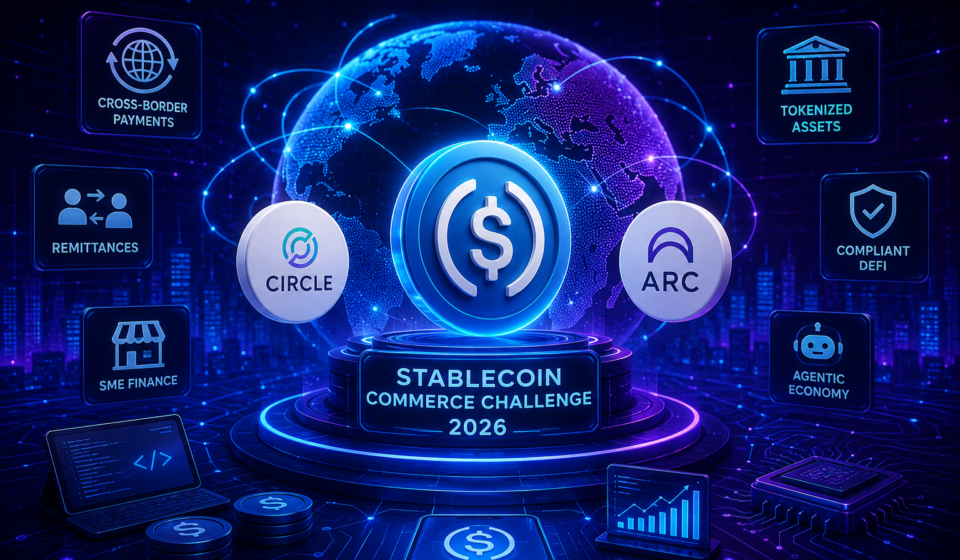
The Stablecoin Commerce Challenge 2026 is a global virtual hackathon that brings together developers, blockchain innovators, and startups to build practical financial applications powered by stablecoins. Organized by Ignyte with technical support from Circle and Arc, the three-month program encourages participants to explore how blockchain technology can solve real-world payment and financial infrastructure challenges.
Unlike traditional hackathons that focus only on decentralized finance (DeFi), this challenge emphasizes practical use cases such as cross-border payments, SME financing, tokenized assets, and AI-driven payment systems. Projects are built for educational purposes and testnet demonstrations, allowing developers to experiment with advanced financial technologies without handling real customer funds.
As stablecoins continue to gain traction in global finance, this challenge offers participants an opportunity to gain hands-on experience with one of the industry’s fastest-growing ecosystems.
What Is the Stablecoin Commerce Challenge 2026?
The Stablecoin Commerce Challenge 2026 is designed to encourage innovation using Circle’s stablecoin infrastructure and Arc’s purpose-built Layer 1 blockchain.
Participants develop working prototypes that demonstrate how programmable money can improve financial services, automate payments, and simplify cross-border transactions.
The challenge focuses on four primary innovation areas:
- Cross-border payments and remittances
- SME finance and trade workflows
- Real-world asset tokenization
- AI-powered agentic commerce
Rather than creating theoretical concepts, teams are expected to build functional applications complete with front-end interfaces, back-end systems, and technical documentation.
Why Arc Is the Preferred Blockchain
Arc is a Layer 1 blockchain specifically designed for stablecoin-native financial applications. Unlike traditional blockchains that rely on volatile native tokens for transaction fees, Arc uses USDC as its gas token, helping developers build applications with predictable transaction costs. It also offers sub-second deterministic finality, EVM compatibility, and tools for payments, treasury management, and AI-powered financial workflows.
Developers interested in building on Arc can explore the official documentation here:
Circle Developer Tools
Circle provides a complete suite of developer tools that simplify building stablecoin-powered applications. These services help developers create secure wallets, automate payments, move USDC across supported blockchains, and integrate smart contracts into financial applications. Circle also offers APIs for contracts, wallets, Gateway, CCTP, and institutional payment flows.
Popular tools used during the challenge include:
- USDC for digital payments and settlements
- Circle Wallets for embedded wallet experiences
- CCTP (Cross-Chain Transfer Protocol) for moving USDC between supported blockchains
- Circle Gateway for treasury management and payment routing
- Nanopayments for high-frequency microtransactions
Developers can access the official resources through:
Why This Challenge Matters
Stablecoins have evolved beyond cryptocurrency trading and are increasingly being used for international payments, business settlements, payroll, and digital commerce. The Stablecoin Commerce Challenge 2026 encourages participants to create solutions that address these practical needs while gaining experience with production-grade blockchain infrastructure.
By combining Circle’s payment technologies with Arc’s stablecoin-native blockchain, developers can prototype scalable financial applications that demonstrate the future of programmable commerce.
Competition Tracks
The Stablecoin Commerce Challenge 2026 features four innovation tracks, allowing participants to focus on different areas of blockchain-powered financial technology.
1. Cross-Border Payments and Remittances
This track challenges developers to create fast, affordable international payment solutions using USDC. Projects may include:
- Remittance platforms
- Global payroll systems
- Marketplace settlement tools
- Merchant payment applications
- Freelancer payout solutions
The goal is to simplify cross-border transactions while reducing costs and improving settlement speed.
2. SME Finance and Trade Workflows
Small and medium-sized businesses often face delays in payments, financing, and international trade. This track encourages developers to build applications that streamline these processes.
Possible projects include:
- Invoice financing platforms
- Stablecoin escrow systems
- Purchase order financing
- Automated settlement workflows
- Digital credit history solutions
These applications aim to improve cash flow and reduce administrative overhead for businesses.
3. Real-World Asset Tokenization
Tokenization is becoming an important part of modern finance. This category focuses on converting physical and traditional financial assets into blockchain-based digital tokens.
Examples include:
- Tokenized real estate
- Fractional bonds
- Digital sukuk
- Commodity-backed tokens
- Compliance monitoring dashboards
Developers are encouraged to incorporate regulatory compliance features such as identity verification, transfer restrictions, and audit capabilities.
4. Agentic Economy
The agentic economy explores how AI agents can autonomously complete financial tasks using blockchain technology.
Potential applications include:
- AI shopping assistants
- Automated subscription payments
- Smart payment routing
- Loyalty reward optimization
- Streaming micropayments
- AI-to-AI payment systems
This track combines artificial intelligence with programmable money to automate digital commerce.
Prize Pool
The challenge offers rewards in USDC for top-performing teams.
Prize distribution includes:
- Cross-Border Payments
- 1st Place: 5,000 USDC
- 2nd Place: 3,000 USDC
- SME Finance
- 1st Place: 5,000 USDC
- 2nd Place: 3,000 USDC
- Real-World Asset Tokenization
- 1st Place: 3,000 USDC
- Agentic Economy
- 1st Place: 4,000 USDC
- 2nd Place: 2,000 USDC
Beyond prize money, participants gain valuable experience building with enterprise-grade blockchain infrastructure.
Submission Requirements
To qualify, teams must submit a complete project package that includes:
- Project title and summary
- Selected challenge track
- Circle Developer Account email
- Circle products integrated into the application
- Functional MVP
- Architecture diagram
- GitHub repository
- Demo video
- Live application (if available)
- Technical documentation
Each submission must also include a Circle Product Feedback section explaining:
- Why Circle products were selected
- Development experience
- Product strengths
- Suggested improvements
- Ideas for enhancing the developer experience
Skills Developers Can Gain
Participating in this challenge helps developers strengthen expertise in:
- Stablecoin development
- Smart contract programming
- Cross-chain infrastructure
- Blockchain payment systems
- Wallet integration
- Treasury management
- Tokenization
- AI-powered financial automation
- Web3 application architecture
These skills are increasingly valuable as financial institutions continue adopting blockchain technology.
Who Should Participate?
The Stablecoin Commerce Challenge 2026 is suitable for:
- Blockchain developers
- Smart contract engineers
- Web3 startups
- FinTech founders
- AI developers
- University students
- Software engineers
- Payment infrastructure companies
Whether you’re building your first decentralized application or scaling enterprise blockchain solutions, the challenge provides practical learning opportunities.
Helpful Resources
Participants can learn more through the official documentation:
- Arc Documentation: https://docs.arc.io/
- Circle Developer Platform: https://www.circle.com/developer
- Circle API Documentation: https://developers.circle.com/
These resources provide tutorials, APIs, SDKs, and implementation guides for building stablecoin-powered applications.
Frequently Asked Questions
Is the challenge open globally?
Yes. Developers from around the world can participate, provided they follow the competition rules and submission requirements.
Is a working prototype required?
Yes. Teams are expected to submit a functional MVP along with supporting documentation, architecture diagrams, and a demonstration video.
Can beginners participate?
Absolutely. While blockchain experience is helpful, the official documentation and developer resources make it accessible for developers with different skill levels.
Are enterprise tools mandatory?
No. Some tools require approval, but teams will not be penalized if they use conceptual integrations when access isn’t available.
Conclusion
The Stablecoin Commerce Challenge 2026 provides an excellent opportunity for developers to build real-world blockchain applications using Circle’s stablecoin ecosystem and the Arc blockchain. By focusing on practical solutions for payments, business finance, tokenized assets, and AI-driven commerce, the challenge encourages innovation that extends beyond traditional cryptocurrency use cases.
Participants not only compete for attractive USDC prizes but also gain hands-on experience with production-ready tools, strengthen their blockchain development skills, and contribute to the future of digital financial infrastructure. Whether you’re an experienced Web3 developer or exploring stablecoin technology for the first time, this challenge offers a valuable platform to learn, collaborate, and showcase innovative ideas.